

1.5.1. The parts and function of the light microscope

WeLearn November 14, 2025
Key Concept:
Understanding the structure and function of each microscope part helps students observe tiny organisms accurately and safely in biological studies.
Short Notes:
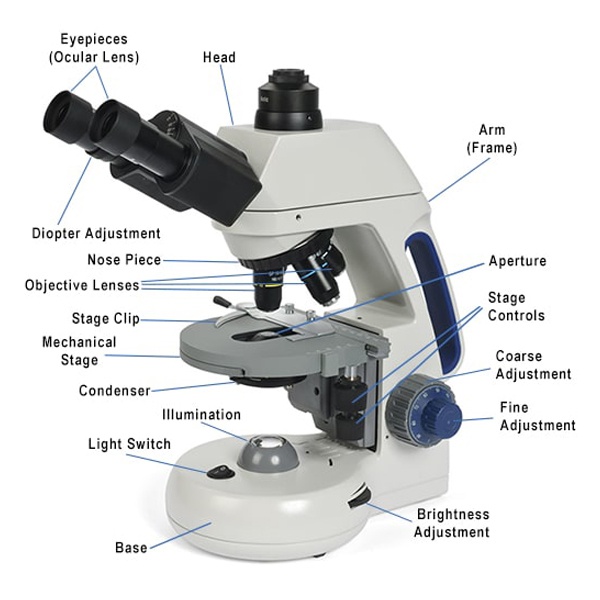
The light microscope is made up of several parts, each with a specific role in magnifying and focusing the image of a specimen. These parts are categorized as mechanical, optical, and light-regulating components. The mechanical parts include the base, arm, stage, and adjustment knobs, which provide support and focus. The optical parts consist of the eyepiece and objective lenses, which magnify the image.
The mirror or illuminator reflects light onto the specimen, while the diaphragm controls the light’s intensity. The coarse adjustment knob is used for rough focusing, and the fine adjustment knob is for sharp, detailed focusing. Correct use of all these parts is necessary to get a clear image and prevent damage to the slide or lens. The total magnification is calculated by multiplying the magnification power of the eyepiece and objective lens.
Key Terms:
- Eyepiece – Lens through which the observer sees the specimen,
- Objective lens – Lens close to the specimen that provides magnification,
- Stage – Platform where slides are placed for viewing,
- Coarse adjustment – Knob used for rough focusing,
- Diaphragm – Controls the amount of light reaching the specimen.
Example:
In Ethiopian high school labs, students use the coarse and fine knobs to clearly observe the nucleus in onion cells under different objective lenses.
ESSLCE Practics Zone:
Click here
— FOR National Exam and Remedial Exam Participants —
Exam Link:
This topic appeared in the Ethiopian National Exam, Year 2016.
Sample ESSLCE Question:
Which microscope part adjusts the amount of light on the specimen?
A. Stage
B. Eyepiece
C. Diaphragm
D. Arm
Correct Answer:
C. Diaphragm
Explanation:
The diaphragm controls the intensity of light that passes through the specimen for better visibility.
Next Topic Preview:
Next, you’ll discover how to properly handle, clean, and store the light microscope — essential skills for safe and effective scientific investigation.
Responses