
Grade 10 · Ethiopian 2023 curriculum
Grade 10 Chemistry
Chemical reactions and stoichiometry, solutions, inorganic compounds, electrochemistry, metals and hydrocarbons.
6
units
30
lessons with notes
36
quiz questions
1
labs & games
Overview
What Grade 10 Chemistry covers
Students balance equations and calculate with the mole, prepare and describe solutions, and classify oxides, acids, bases and salts. Later units cover electrochemical cells and electrolysis, production of metals and non-metals, and hydrocarbons and their natural sources.
Units
Grade 10 Chemistry units and lessons
Unit 1
Chemical Reactions and Stoichiometry
- • Introduction
- • Chemical Equations
- • Types of Chemical Reactions
- • Oxidation and Reduction Reactions
- • Formula Masses, the Mole Concept and Chemical Formulas
- • Stoichiometry
Unit 2
Solutions
- • Heterogeneous and Homogeneous Mixtures
- • The Solution Process
- • Solubility as an Equilibrium Process
- • Ways of Expressing Concentration
- • Preparation of Solutions
- • Solution Stoichiometry
- • Describing Reactions in Solution
Unit 3
Important Inorganic Compounds
- • Introduction
- • Oxides
- • Acids
- • Bases
- • Salts
Unit 4
Energy Changes and Electrochemistry
- • Introduction
- • Energy Changes in Electrochemistry
- • Electrochemical Cells
- • Electrolysis
Unit 5
Metals and Nonmetals
- • Introduction
- • General Properties of Metals and Production of Some Metals
- • Production of Some Important Nonmetals
Unit 6
Hydrocarbons and their Natural Sources
- • Introduction
- • Saturated Hydrocarbons: Alkanes
- • Unsaturated Hydrocarbons: Alkenes and Alkynes
- • Aromatic Hydrocarbons: Benzene
- • Natural Sources of Hydrocarbons
Virtual labs & games
Used in Grade 10 Chemistry
FAQ
About Grade 10 Chemistry
What do students learn in Grade 10 Chemistry?
Students balance equations and calculate with the mole, prepare and describe solutions, and classify oxides, acids, bases and salts. Later units cover electrochemical cells and electrolysis, production of metals and non-metals, and hydrocarbons and their natural sources.
How many units are in Grade 10 Chemistry?
Grade 10 Chemistry has 6 units: Unit 1, Chemical Reactions and Stoichiometry; Unit 2, Solutions; Unit 3, Important Inorganic Compounds; Unit 4, Energy Changes and Electrochemistry; Unit 5, Metals and Nonmetals; Unit 6, Hydrocarbons and their Natural Sources.
Are there virtual labs or games for Grade 10 Chemistry?
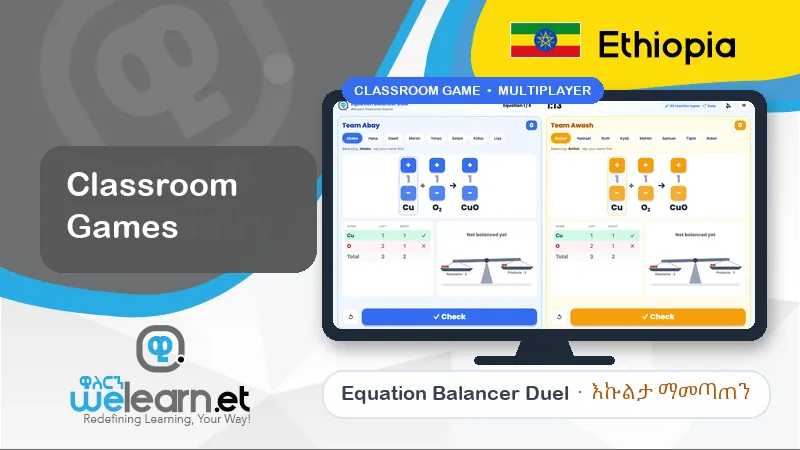
Yes: Equation Balancer Duel (classroom game, Grade 10). They open inside the matching lessons on WeLearn.
Teach Grade 10 Chemistry with WeLearn
We will bring a demo to your school: a lesson on your interactive TV, a virtual lab and a classroom game, with your own teachers.