
A function is a special relation in which every element of the domain is paired with exactly one element of the range. We write f: A → B and f(x) = y, read 'f of x equals y'. The input x is the independent variable and the output y is the dependent variable. A relation such as {(1, 2), (1, 3)} is not a function because the input 1 has two different outputs, but {(1, 2), (3, 2)} is a function: two inputs may share the same output.
Key terms
- Function
- a relation in which each input has exactly one output
- Vertical line test
- a graph is a function if no vertical line meets it twice
- One-to-one
- different inputs give different outputs
- Onto
- every element of the codomain is an output
- Composition
- applying one function to the output of another, g(f(x))
- Inverse function
- a function f⁻¹ with f⁻¹(f(x)) = x
Key formulas
Summary
- A function gives exactly one output for each input.
- Domains exclude zero denominators and negative values under even roots.
- Only one-to-one functions have inverses; find them by swapping x and y.
- Composition order matters: g ∘ f usually differs from f ∘ g.
In everyday life: An Ethio Telecom airtime voucher is a function: each scratch-card number is linked to exactly one value in Birr, so the system never gives two different balances for the same code.
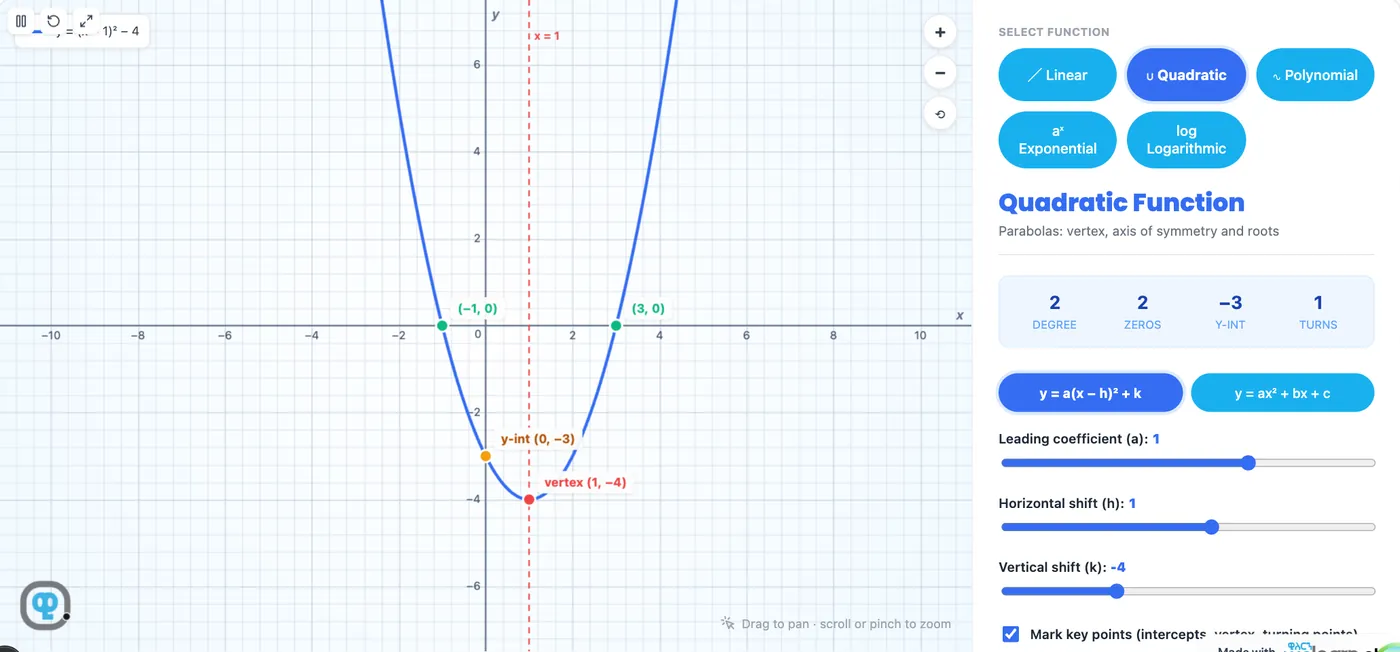
Try it in a virtual lab
Check yourself
- Is {(2, 3), (4, 3), (5, 1)} a function? Is it one-to-one?
- Find the domain of f(x) = 1/(x² − 4).
- If f(x) = 3x − 2, find f⁻¹(x).
- Why does a circle fail the vertical line test?
Practice questions
1. What is the domain of f(x) = 1/(x − 4)?
- A. All real numbers
- B. x > 4
- C. x ≠ 4
- D. x ≠ 0
Show answer
Answer: x ≠ 4
The denominator cannot be zero, so x − 4 ≠ 0, i.e. x ≠ 4. Every other real number gives a valid output.
2. True or false: The relation {(1, 2), (1, 3), (2, 4)} is a function.
Show answer
Answer: False
The input 1 is paired with two different outputs (2 and 3), so it is a relation but not a function.
On WeLearn
The full lesson: reading notes, worked examples, class activities and the Unit 1 quiz
Study Functions on WeLearnTeach Functions with WeLearn
We will bring a demo to your school: a lesson on your interactive TV, a virtual lab and a classroom game, with your own teachers.