
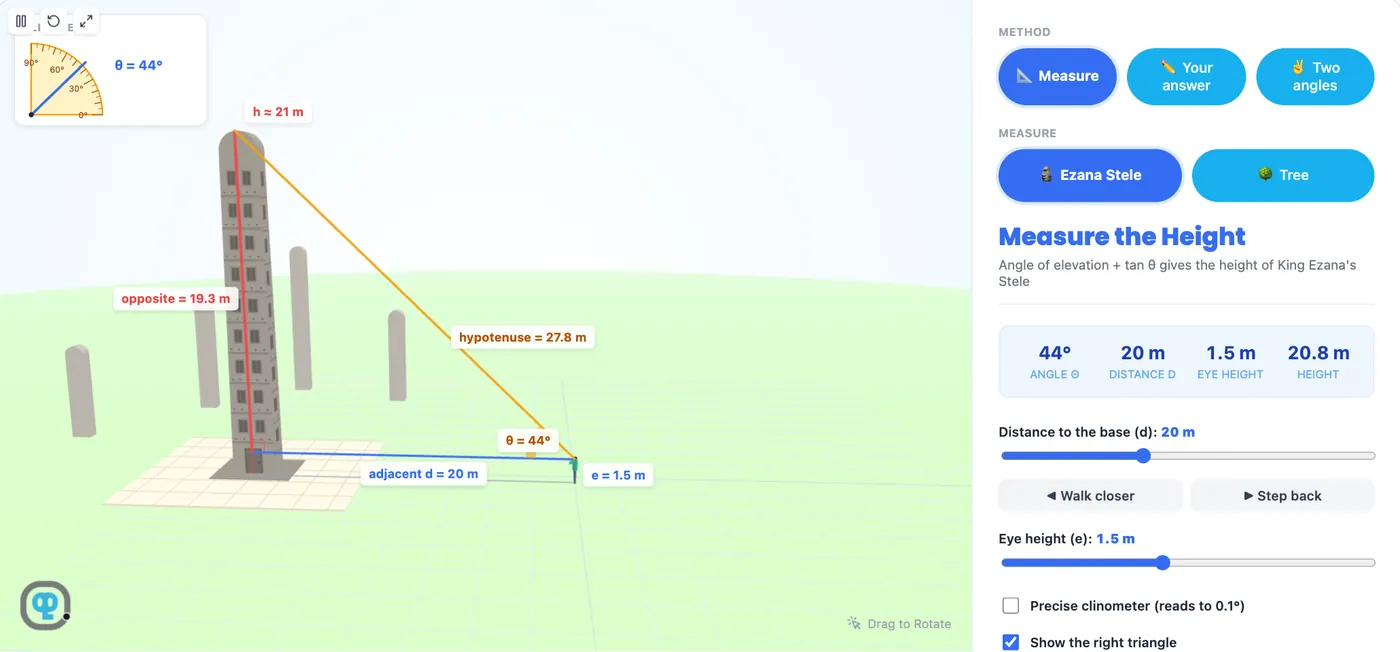
Trigonometry was developed to measure what cannot be measured directly: heights of mountains, widths of rivers and distances to stars. In a right-angled triangle, if one side and one acute angle are known, the other sides follow from sin, cos or tan. The angle of elevation is measured upward from the horizontal to an object above the observer, and the angle of depression is measured downward from the horizontal to an object below. These two angles are equal when they describe the same line of sight, because they are alternate angles.
Key terms
- Angle of elevation
- angle above the horizontal to an object
- Angle of depression
- angle below the horizontal to an object
- Law of Sines
- a/sin A = b/sin B = c/sin C
- Law of Cosines
- c² = a² + b² − 2ab cos C
- Bearing
- direction measured clockwise from north
Key formulas
Summary
- Use right-triangle ratios with angles of elevation and depression.
- Law of Sines and Law of Cosines solve any triangle.
- Area = ½ab sin C.
- Sine curves model periodic phenomena.
In everyday life: Ethiopian Airlines pilots and air-traffic controllers at Bole use bearings and triangle laws to plan approach paths and keep aircraft safely apart.
Try it in a virtual lab

Check yourself
- A ladder 6 m long makes 70° with the ground. How high does it reach?
- In triangle ABC, a = 10, A = 30°, B = 45°. Find b.
- Write the bearing for south-west as a three-figure angle.
Practice questions
1. From 50 m away, the angle of elevation of a tower's top is 45°. Find the tower's height in metres.
Show answer
Answer: 50
tan 45° = h/50 and tan 45° = 1, so h = 50 m.
On WeLearn
The full lesson: reading notes, worked examples, class activities and the Unit 4 quiz
Study Applications on WeLearnTeach Applications with WeLearn
We will bring a demo to your school: a lesson on your interactive TV, a virtual lab and a classroom game, with your own teachers.