
A prism is a solid with two congruent, parallel polygonal faces called bases, joined by rectangular (or parallelogram) lateral faces. It is named after its base: triangular prism, rectangular prism (cuboid), hexagonal prism and so on. In a right prism the lateral edges are perpendicular to the bases. A cylinder is like a prism with a circular base: two parallel congruent circles joined by a curved surface.
Key terms
- Prism
- solid with two congruent parallel polygon bases
- Right prism
- lateral edges perpendicular to the bases
- Cylinder
- solid with two parallel congruent circular bases
- Lateral surface area
- area of the side faces only
- Total surface area
- lateral area plus both bases
- Net
- a flat pattern that folds into a solid
Key formulas
Summary
- Volume of prism or cylinder = base area × height.
- Lateral area of a right prism = base perimeter × height.
- Cylinder total surface = 2πrh + 2πr².
- 1 m³ = 1000 L.
In everyday life: Households in Ethiopia store water in cylindrical plastic tanks (roto tanks); the capacity printed on them comes from V = πr²h.
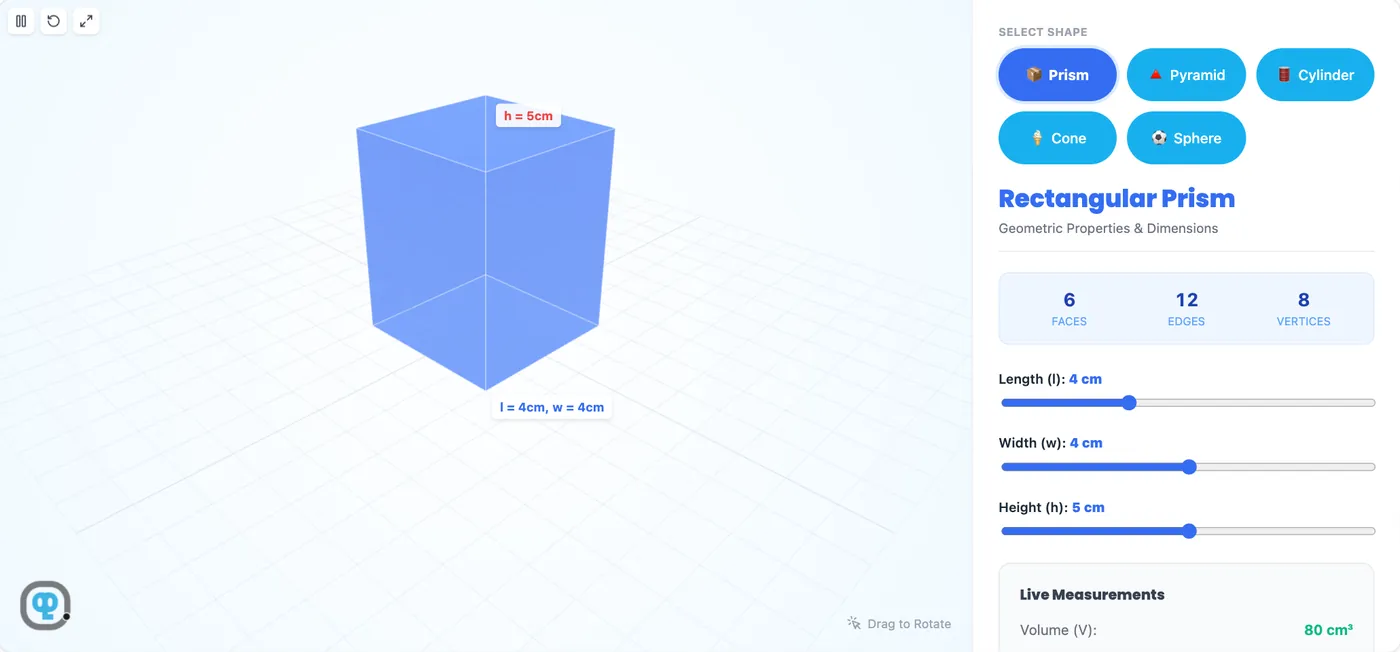
Try it in a virtual lab
Check yourself
- Find the volume of a cuboid 5 cm × 4 cm × 3 cm.
- Find the curved surface area of a cylinder with r = 7 cm, h = 10 cm (π ≈ 22/7).
- Why does doubling the radius of a cylinder multiply its volume by 4?
Practice questions
1. Find the volume (cm³) of a cylinder with radius 7 cm and height 10 cm. Use π = 22/7.
Show answer
Answer: 1540
V = πr²h = 22/7 × 49 × 10 = 1540 cm³ — base area times height.
On WeLearn
The full lesson: reading notes, worked examples, class activities and the Unit 6 quiz
Study Revision of Cylinders and Prisms on WeLearnTeach Revision of Cylinders and Prisms with WeLearn
We will bring a demo to your school: a lesson on your interactive TV, a virtual lab and a classroom game, with your own teachers.