
Coordinate geometry turns geometric questions into algebra that can be computed. Surveyors, architects, map makers, game designers and GPS systems all describe positions with coordinates and use the formulas of this unit: distance for lengths, section formula for points between others, slopes for direction and steepness, and circle equations for ranges and round shapes.
Key terms
- Coordinate proof
- proving a geometric fact using coordinates
- Shoelace (area) formula
- area of a polygon from its vertices
- Linear model
- a line fitted through data points
- Locus
- the set of points satisfying a condition
Key formulas
Summary
- Coordinates turn geometry into algebra.
- Place figures conveniently for proofs.
- Area of a triangle from vertices; zero area means collinear.
- Two points give a linear model for prediction.
In everyday life: The Ethiopian land-certification programme records farm plots by the coordinates of their corners, from which the area of each plot is calculated.
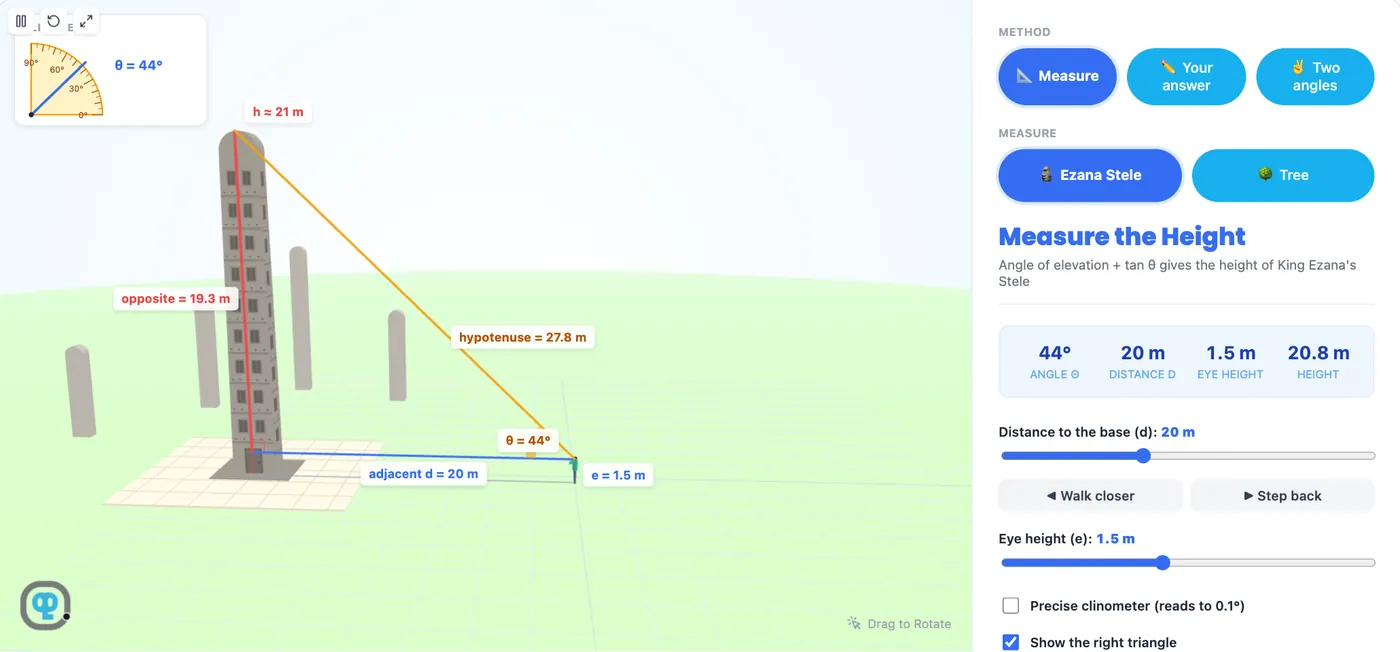
Try it in a virtual lab

Check yourself
- Find the area of the triangle with vertices (1, 1), (5, 1), (1, 4).
- Use coordinates to show the midpoint of a right triangle's hypotenuse is equidistant from all vertices.
- Are (1, 2), (3, 6), (5, 10) collinear?
Practice questions
1. True or false: The points (0, 0), (2, 3) and (4, 6) are collinear.
Show answer
Answer: True
The slope from (0,0) to (2,3) and from (2,3) to (4,6) is 3/2 in both cases, so the area of the triangle is zero and the points lie on one line.
On WeLearn
The full lesson: reading notes, worked examples, class activities and the Unit 7 quiz
Study Applications on WeLearnTeach Applications with WeLearn
We will bring a demo to your school: a lesson on your interactive TV, a virtual lab and a classroom game, with your own teachers.