
Grade 10 · Ethiopian 2023 curriculum
Grade 10 Physics
Vectors, accelerated motion, elasticity, electricity, magnetism, electromagnetic waves and optics.
6
units
45
lessons with notes
36
quiz questions
3
labs & games
Overview
What Grade 10 Physics covers
Grade 10 physics introduces vectors and the equations of uniformly accelerated motion, then elasticity and static equilibrium. Students build and analyse electric circuits, study magnetism and its applications, and finish with the electromagnetic spectrum, mirrors, lenses, the eye and colour.
Units
Grade 10 Physics units and lessons
Unit 1
Vector Quantities
- • Scalars and Vectors
- • Vector Representations
- • Vector Addition and Subtraction
- • Graphical Method of Vector Addition
- • Vector Resolution
Unit 2
Uniformly Accelerated Motion
- • Position and Displacement
- • Average and Instantaneous Velocity
- • Acceleration
- • Equations of Motion with Constant Acceleration
- • Graphs of Uniformly Accelerated Motion
- • Relative Velocity in One Dimension
Unit 3
Elasticity and Static Equilibrium of Rigid Bodies
- • Elasticity and Plasticity
- • Density and Specific Gravity
- • Stress and Strain
- • The Young Modulus
- • Static Equilibrium
Unit 4
Static and Current Electricity
- • Charges in Nature
- • Methods of Charging a Body
- • The Electroscope
- • Electrical Discharge
- • Coulomb's Law of Electrostatics
- • The Electric Field
- • Electric Circuits
- • Current, Voltage and Ohm's Law
- • Combination of Resistors in a Circuit
- • Voltmeter and Ammeter Connection
- • Electrical Safety
- • Electric Projects
Unit 5
Magnetism
- • Magnets
- • Magnetic Field
- • The Earth's Magnetic Field and the Compass
- • Magnetic Field of a Current-carrying Conductor
- • Magnetic Force on a Moving Charge
- • Magnetic Force on a Current-carrying Wire
- • Force between Two Parallel Current-carrying Wires
- • Applications of Magnetism
Unit 6
Electromagnetic Waves and Geometrical Optics
- • Electromagnetic Waves
- • The Electromagnetic Spectrum
- • Light as a Wave
- • Laws of Reflection and Refraction
- • Mirrors and Lenses
- • The Human Eye and Optical Instruments
- • Primary Colors of Light and Human Vision
- • Color Addition of Light
- • Color Subtraction of Light Using Filters
Virtual labs & games
Used in Grade 10 Physics
 Virtual lab
Physics · Grade 10
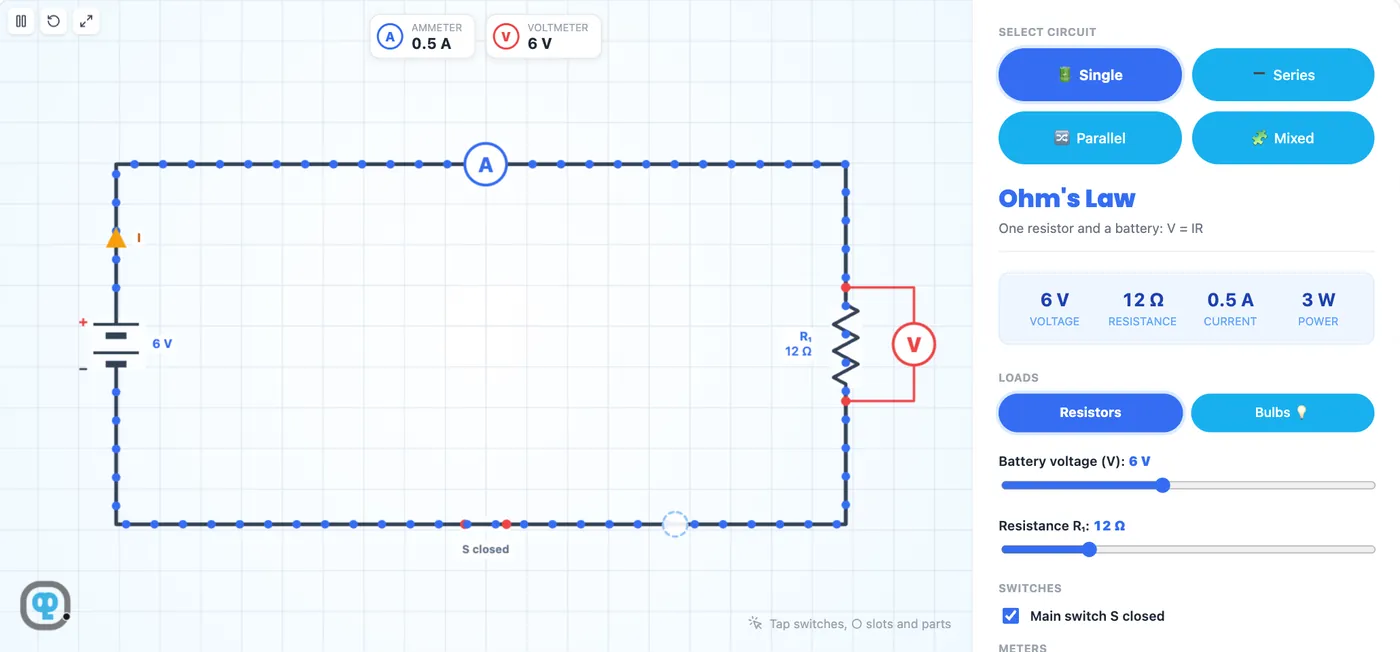
Circuit Builder: Ohm's Law, Series & Parallel
Configure single, series, parallel and mixed resistor circuits: set the battery voltage and each resistance, flip switches, watch bulbs glow and charges flow, and place an ammeter and a voltmeter to measure current and potential difference.
Used in 4 lessons
 Virtual lab
Physics · Grade 10
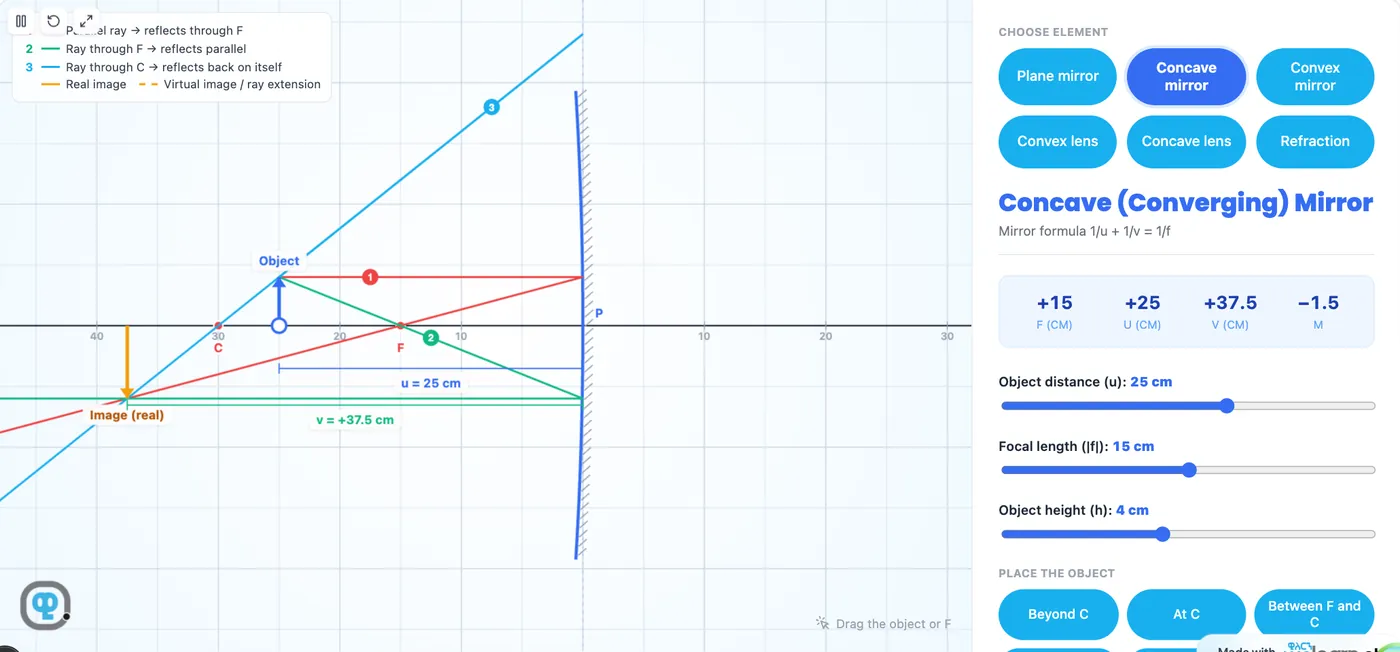
Optics Bench: Mirrors and Lenses
Place an object in front of plane, concave and convex mirrors or convex and concave lenses, change the focal length and watch the construction rays find the image. Measures u, v, m and the nature of the image with the textbook's real-is-positive sign convention. A refraction bench shows Snell's law through a glass block and the critical angle.
Used in 3 lessons
 Classroom game
Physics · Grades 9–10
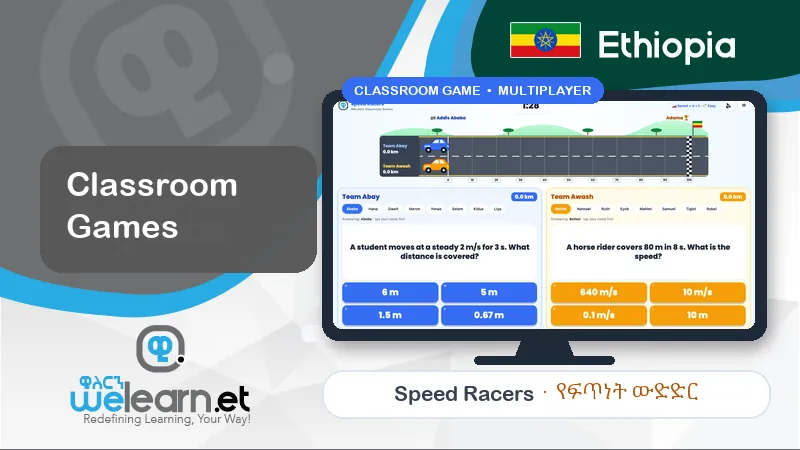
Speed Racers
የፍጥነት ውድድር
Two team cars race from Addis Ababa to Adama: every right answer accelerates your car, fast answers boost harder and wrong ones skid. Speed, km/h ↔ m/s, average speed, acceleration, motion graphs and the equations of motion.
Used in 8 lessons
FAQ
About Grade 10 Physics
What do students learn in Grade 10 Physics?
Grade 10 physics introduces vectors and the equations of uniformly accelerated motion, then elasticity and static equilibrium. Students build and analyse electric circuits, study magnetism and its applications, and finish with the electromagnetic spectrum, mirrors, lenses, the eye and colour.
How many units are in Grade 10 Physics?
Grade 10 Physics has 6 units: Unit 1, Vector Quantities; Unit 2, Uniformly Accelerated Motion; Unit 3, Elasticity and Static Equilibrium of Rigid Bodies; Unit 4, Static and Current Electricity; Unit 5, Magnetism; Unit 6, Electromagnetic Waves and Geometrical Optics.
Are there virtual labs or games for Grade 10 Physics?
Yes: Circuit Builder: Ohm's Law, Series & Parallel (virtual lab, Grade 10), Optics Bench: Mirrors and Lenses (virtual lab, Grade 10), Speed Racers (classroom game, Grades 9–10). They open inside the matching lessons on WeLearn.
Teach Grade 10 Physics with WeLearn
We will bring a demo to your school: a lesson on your interactive TV, a virtual lab and a classroom game, with your own teachers.