
Grade 11 · Ethiopian 2023 curriculum
Grade 11 Physics
Physics in society, vectors, motion in two dimensions, dynamics, heat, electrostatics and nuclear physics.
7
units
37
lessons with notes
42
quiz questions
2
labs & games
Overview
What Grade 11 Physics covers
Grade 11 physics explores physics careers and communities, vector algebra, projectile and circular motion, Newton's laws, energy and momentum. Students then study heat transfer and calorimetry, electric fields, potential and capacitors, and radioactivity and nuclear energy.
Units
Grade 11 Physics units and lessons
Unit 1
Physics and Human Society
- • Importance of Physics to Society
- • Physics Communities and their Roles
- • Making of Physics Knowledge
- • The Mission of Physics and Career Awareness
- • Current Status of Physics
Unit 2
Vectors
- • Vectors and Types of Vectors
- • Graphical Addition of Vectors in Two Dimensions
- • Algebraic Addition of Vectors in Two Dimensions
- • Product of Vectors
Unit 3
Motion in One and Two Dimensions
- • Uniformly Accelerated Motion in 1D
- • Equations of Uniformly Accelerated Motion in 1D
- • Graphs of Uniformly Accelerated Motion in 1D
- • Vertical Motion
- • Uniform Circular Motion
Unit 4
Dynamics
- • Force and Newton's Laws of Motion
- • Frictional Force
- • The First Condition of Equilibrium
- • Work, Energy and Power
- • Conservation of Mechanical Energy
- • Impulse and Linear Momentum
Unit 5
Heat Conduction and Calorimetry
- • The Concept of Heat
- • Heat Transfer Mechanisms
- • Heat Capacity and Specific Heat Capacity
- • Thermal Expansion
- • Change of Phase
- • Calorimetry
Unit 6
Electrostatics and Electric Circuits
- • Coulomb's Law
- • Electric Fields
- • Electric Potential
- • Electric Current, Resistance and Ohm's Law
- • Capacitors and Capacitance
- • Electric Circuits in Our Surroundings
Unit 7
Nuclear Physics
- • The Nucleus
- • Radioactivity
- • Uses of Nuclear Radiation
- • Nuclear Reactions and Energy Production
- • Safety Rules against Nuclear Radiation Hazards
Virtual labs & games
Used in Grade 11 Physics
 Virtual lab
Physics · Grades 11–12
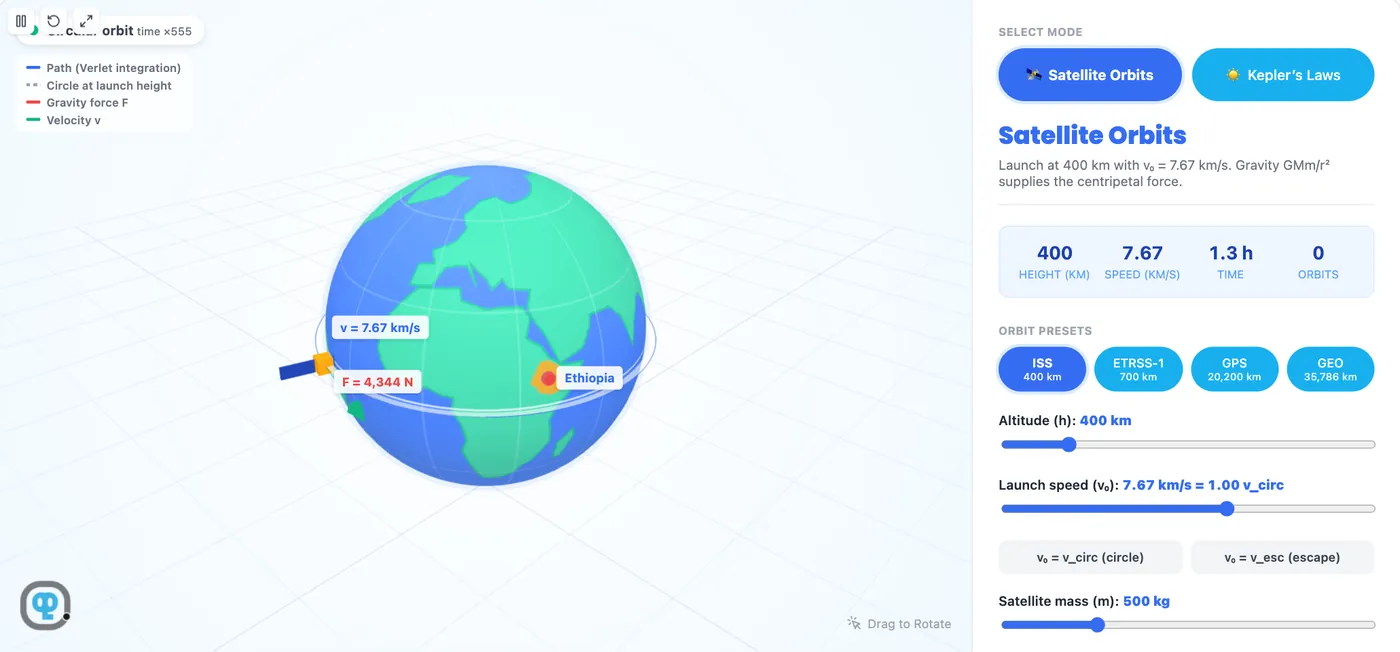
Orbits & Gravity
Launch satellites around Earth (ISS, Ethiopia's ETRSS-1, GPS, geostationary) and see circular, elliptical and escape orbits; explore Kepler's three laws with equal-area sweeps and real planet data. Real constants, orbits integrated with velocity Verlet.
Used in 3 lessons
 Virtual lab
Physics · Grades 11–12
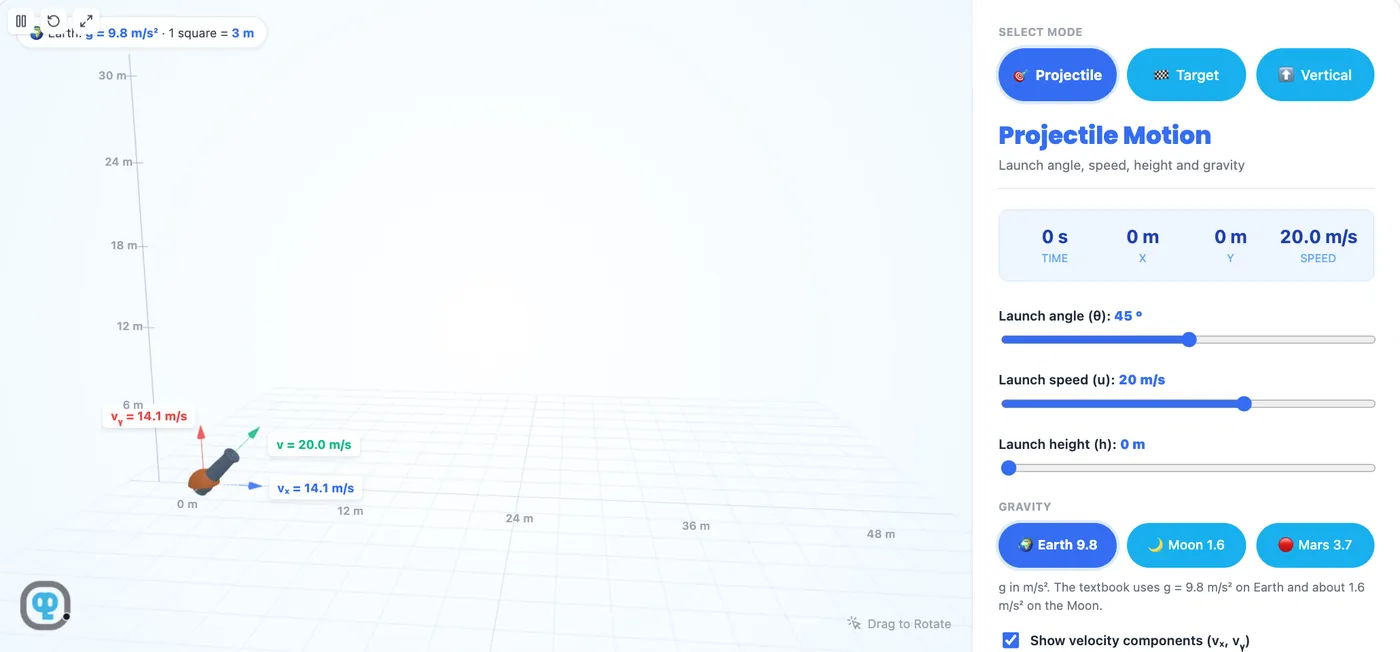
Projectile Motion
Fire a ball from a cannon on Earth, the Moon or Mars: set the launch angle, speed and height, watch the trajectory and its velocity components, compare shots, hit a target, and throw straight up to see the up/down symmetry of vertical motion.
Used in 2 lessons
FAQ
About Grade 11 Physics
What do students learn in Grade 11 Physics?
Grade 11 physics explores physics careers and communities, vector algebra, projectile and circular motion, Newton's laws, energy and momentum. Students then study heat transfer and calorimetry, electric fields, potential and capacitors, and radioactivity and nuclear energy.
How many units are in Grade 11 Physics?
Grade 11 Physics has 7 units: Unit 1, Physics and Human Society; Unit 2, Vectors; Unit 3, Motion in One and Two Dimensions; Unit 4, Dynamics; Unit 5, Heat Conduction and Calorimetry; Unit 6, Electrostatics and Electric Circuits; Unit 7, Nuclear Physics.
Are there virtual labs or games for Grade 11 Physics?
Yes: Orbits & Gravity (virtual lab, Grades 11–12), Projectile Motion (virtual lab, Grades 11–12). They open inside the matching lessons on WeLearn.
Teach Grade 11 Physics with WeLearn
We will bring a demo to your school: a lesson on your interactive TV, a virtual lab and a classroom game, with your own teachers.