
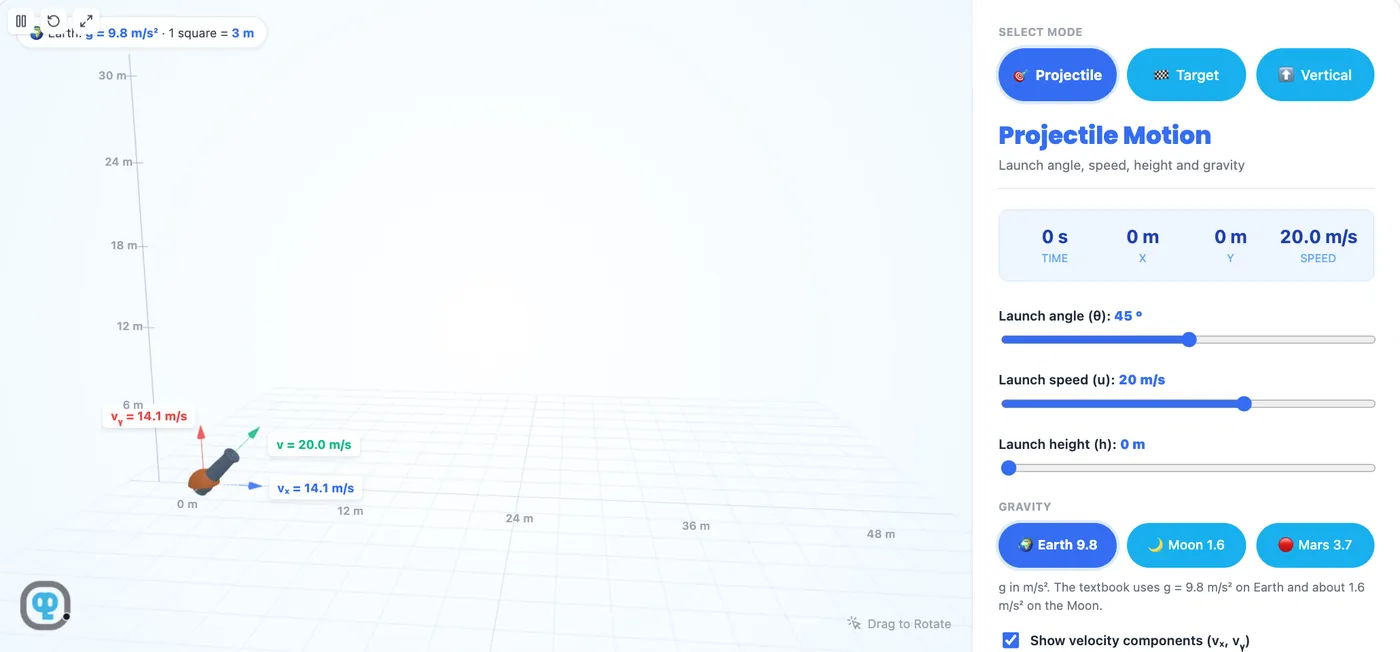
A projectile is any object that, after being launched, moves only under the influence of gravity (air resistance is ignored). A kicked football, a thrown stone and water from a hose are examples. Its path, called the trajectory, is a parabola.
Key terms
- Projectile
- object moving under gravity alone
- Trajectory
- the curved path of a projectile
- Range
- horizontal distance travelled
- Time of flight
- total time in the air
- Maximum height
- highest vertical point reached
- Angle of projection
- launch angle above the horizontal
Key formulas
Summary
- Horizontal and vertical motions are independent.
- u_x is constant; vertical motion has a = g downward.
- Range is maximum at 45° on level ground.
- Fall time depends only on height, not horizontal speed.
In everyday life: Ethiopian athletes in javelin and shot put, and farmers throwing seed or water in an arc, use projectile motion; release angle and speed decide how far it goes.
Try it in a virtual lab
Check yourself
- What is the vertical velocity at the top of the path?
- Find the range of a ball launched at 10 m/s at 45° (g = 10 m/s²).
- Which hits the ground first: a dropped stone or one thrown horizontally?
Practice questions
1. True or false: The horizontal and vertical motions of a projectile are independent.
Show answer
Answer: True
That is why we treat them separately.
2. At what launch angle (degrees) is a projectile's range greatest (no air resistance)?
Show answer
Answer: 45
sin 2θ is maximum when θ = 45°.
On WeLearn
The full lesson: reading notes, worked examples, class activities and the Unit 2 quiz
Study Projectile Motion on WeLearnTeach Projectile Motion with WeLearn
We will bring a demo to your school: a lesson on your interactive TV, a virtual lab and a classroom game, with your own teachers.