
A covalent bond is formed when two atoms share a pair of electrons. It usually forms between nonmetal atoms, which all tend to gain electrons, so neither can take an electron from the other. The shared pair is attracted to both nuclei, and this holds the atoms together. In H2, each hydrogen atom shares its single electron, so both have a duplet. In Cl2, each chlorine shares one electron, and both atoms reach an octet.
Key terms
- Covalent bond
- a shared pair of electrons between two atoms
- Lone pair
- a pair of valence electrons not used in bonding
- Double/triple bond
- two or three shared pairs
- Polar covalent bond
- unequal sharing due to an electronegativity difference
- Coordinate (dative) bond
- shared pair donated by one atom
- Giant covalent structure
- network of atoms linked by covalent bonds, e.g. diamond
Summary
- Covalent bonds are shared electron pairs between nonmetals.
- Single, double and triple bonds share 1, 2 and 3 pairs.
- Unequal sharing makes polar bonds.
- Simple molecules have low melting points; giant covalent networks are very hard.
In everyday life: The methane in biogas produced from cow dung in rural Ethiopian homes is a covalent molecule (CH4). Its low boiling point is why it is a gas that can be piped to a stove.
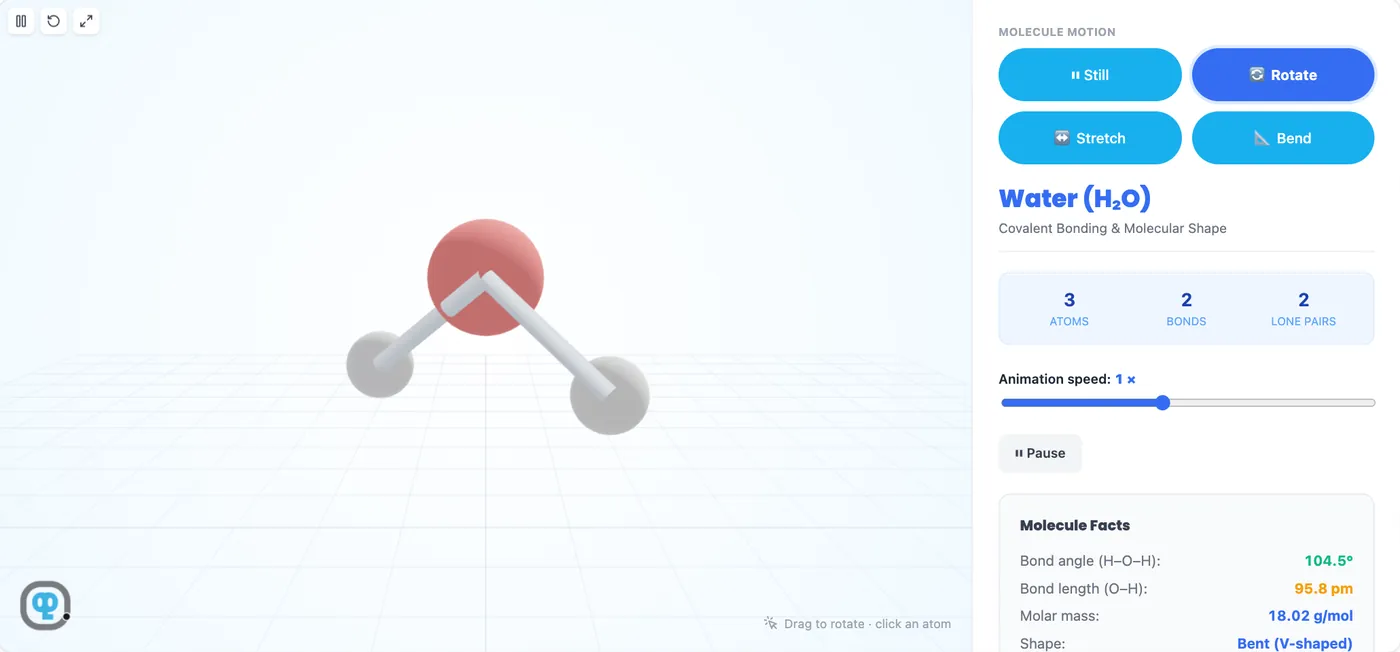
Try it in a virtual lab
Check yourself
- What is a lone pair?
- How many bonds and lone pairs does water have?
- Why is the H–Cl bond polar?
- Why don't covalent molecules conduct electricity?
Practice questions
1. Which compound is covalent?
- A. NaCl
- B. MgO
- C. H₂O
- D. KBr
Show answer
Answer: H₂O
Water is made of non-metals sharing electrons.
2. How many electron pairs are shared in a triple bond?
Show answer
Answer: 3
A triple bond shares three pairs.
On WeLearn
The full lesson: reading notes, worked examples, class activities and the Unit 5 quiz
Study Covalent Bonding on WeLearnTeach Covalent Bonding with WeLearn
We will bring a demo to your school: a lesson on your interactive TV, a virtual lab and a classroom game, with your own teachers.