
Grade 9 · Ethiopian 2023 curriculum
Grade 9 History
From human evolution and ancient civilizations to Aksum, medieval Ethiopia and the age of revolutions.
9
units
54
lessons with notes
54
quiz questions
1
labs & games
Overview
What Grade 9 History covers
Grade 9 history introduces the discipline of history and Africa's place in human evolution, then surveys ancient civilizations of Africa, Asia, the Americas and Europe. Ethiopian history runs from Aksum and the Zagwe to the Gondarine period and Zemene Mesafint, alongside Africa's states and the age of revolutions.
Units
Grade 9 History units and lessons
Unit 1
The Discipline of History and Human Evolution
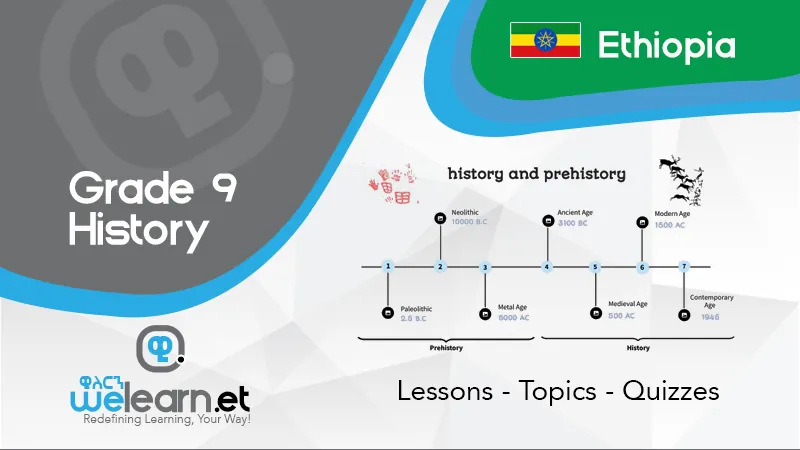
- • Meaning of Prehistory and History
- • The Discipline of History
- • The Evolution of Human Beings
- • The Stone Age
- • The Emergence of States
Unit 2
Ancient World Civilizations up to c. 500 AD
- • Ancient Civilizations of Africa
- • Civilizations in Asia
- • Ancient Civilizations of Latin America
- • Civilizations in Europe
- • Rise and Spread of Christianity
Unit 3
Peoples and States in Ethiopia and the Horn to the End of the 13th Century
- • Languages, Religions and Peoples of Ethiopia and the Horn
- • Pre-Aksumite States and their Geographical Setting
- • The Aksumite Kingdom
- • The Zagwe Dynasty
- • The Sultanate of Shewa
Unit 4
The Middle Ages and Early Modern World, c. 500 to 1750s
- • The Middle Ages in Europe
- • The Middle Ages in Asia
- • Development of Early Capitalism
- • The Age of Explorations and Discoveries
- • The Renaissance
- • The Reformation
- • Industrial Revolution
Unit 5
Peoples and States of Africa to 1500
- • Languages and Peoples of Africa
- • States in North Africa
- • Spread of Islam and its Impact in West Africa
- • States in Western Africa
- • Equatorial, Central and Eastern Africa
- • Southern Africa
- • Africa's Intra and Inter-continental Relations
- • Trans-Saharan Trade
- • Early Contacts with the Outside World
Unit 6
Africa and the Outside World, 1500 - 1880s
- • Contact with the Outside World
- • Slavery
- • The 'Legitimate' Trade
- • The White Settlement in South Africa
- • European Explorers and Missionaries
Unit 7
States, Principalities and Population Movements in Ethiopia, 13th to Mid-16th Century
- • The 'Solomonic' Dynasty and the Christian Kingdom
- • The Muslim Principalities
- • The Christian Kingdom and the Sultanate of Adal, 1520s - 1559
- • Southern and Central States in Ethiopia
- • Population Movements, Expansion and Integration
- • Gadaa System of the Oromo
- • Moggasa and Guddifacha
- • Egalitarian System of Governance
Unit 8
Political, Social and Economic Processes in Ethiopia, Mid-16th to Mid-19th Century
- • Peoples and States of the Eastern, Central, Southern and Western Regions
- • The Gondarine Period
- • The Zemene-Mesafint (Era of Warlords)
- • The Yejju Dynasty
- • The Kingdom of Shewa
Unit 9
The Age of Revolutions, 1750s to 1815
- • Industrial Capitalism in Europe
- • The French Revolution
- • The Napoleonic Era
- • American War of Independence
- • The Congress of Vienna
Virtual labs & games
Used in Grade 9 History

FAQ
About Grade 9 History
What do students learn in Grade 9 History?
Grade 9 history introduces the discipline of history and Africa's place in human evolution, then surveys ancient civilizations of Africa, Asia, the Americas and Europe. Ethiopian history runs from Aksum and the Zagwe to the Gondarine period and Zemene Mesafint, alongside Africa's states and the age of revolutions.
How many units are in Grade 9 History?
Grade 9 History has 9 units: Unit 1, The Discipline of History and Human Evolution; Unit 2, Ancient World Civilizations up to c. 500 AD; Unit 3, Peoples and States in Ethiopia and the Horn to the End of the 13th Century; Unit 4, The Middle Ages and Early Modern World, c. 500 to 1750s; Unit 5, Peoples and States of Africa to 1500; Unit 6, Africa and the Outside World, 1500 - 1880s; Unit 7, States, Principalities and Population Movements in Ethiopia, 13th to Mid-16th Century; Unit 8, Political, Social and Economic Processes in Ethiopia, Mid-16th to Mid-19th Century; Unit 9, The Age of Revolutions, 1750s to 1815.
Are there virtual labs or games for Grade 9 History?
Yes: Timeline Showdown (classroom game, Grades 9–10). They open inside the matching lessons on WeLearn.
Teach Grade 9 History with WeLearn
We will bring a demo to your school: a lesson on your interactive TV, a virtual lab and a classroom game, with your own teachers.