
A quadratic equation has the form ax² + bx + c = 0 with a ≠ 0. It can have two, one or no real solutions. Three main methods solve it: factorisation, completing the square, and the quadratic formula. Factorising uses the zero-product rule: if pq = 0 then p = 0 or q = 0. For example x² - 5x + 6 = 0 becomes (x - 2)(x - 3) = 0, so x = 2 or x = 3.
Key terms
- Quadratic equation
- ax² + bx + c = 0, a ≠ 0
- Zero-product rule
- if pq = 0 then p = 0 or q = 0
- Completing the square
- writing x² + bx as a perfect square minus a constant
- Discriminant D = b² - 4ac
- Extraneous root
- a value produced by the method that does not satisfy the original equation
- Absolute value equation
- |expression| = a
Key formulas
Summary
- Quadratics: factorise, complete the square or use the formula.
- D = b² - 4ac tells the number of real roots.
- |x| = a gives x = ±a when a ≥ 0.
- Check rational and radical equations for extraneous roots.
In everyday life: A farmer with 100 m of fencing who wants a rectangular plot of 600 m² must solve x(50 - x) = 600, a quadratic equation.
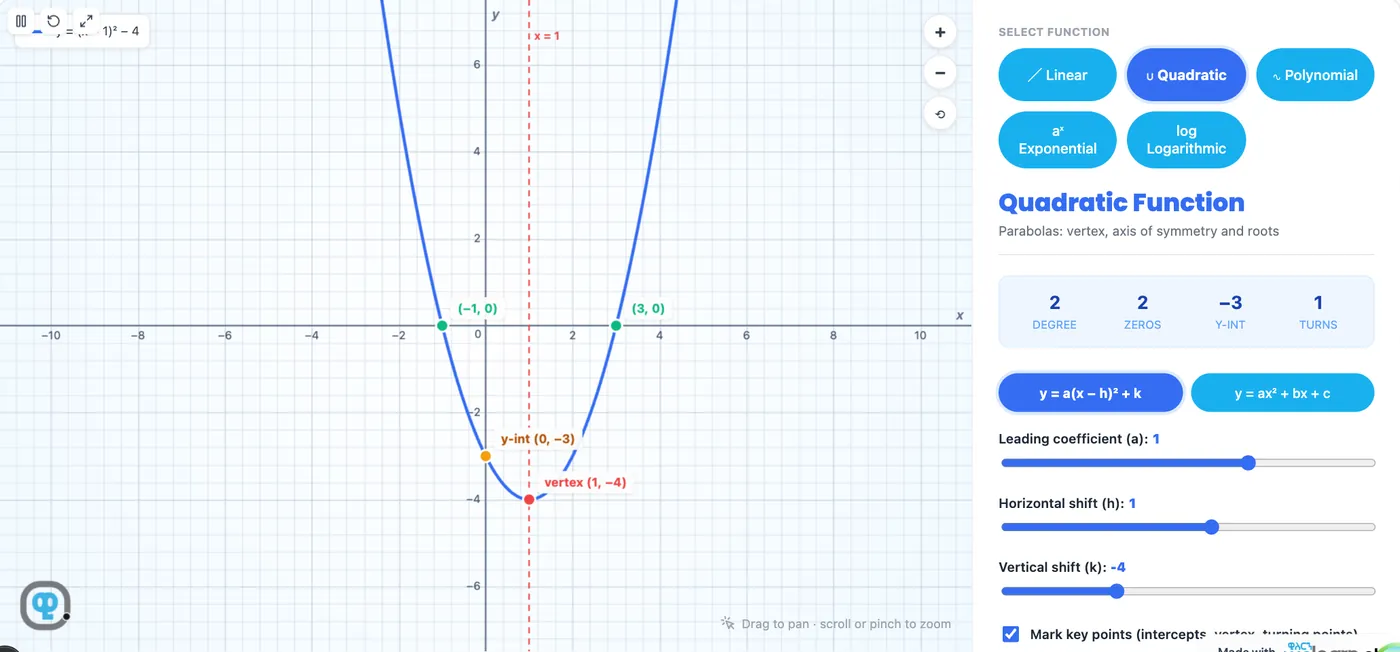
Try it in a virtual lab
Check yourself
- Solve x² - 9x + 20 = 0 by factorising.
- Find D for 3x² - 2x + 1 = 0.
- Solve |x + 3| = 5.
- Why might squaring create false roots?
Practice questions
1. How many real roots does x² + 4x + 7 = 0 have?
- A. Two
- B. One
- C. None
- D. Infinitely many
Show answer
Answer: None
The discriminant is D = 16 - 28 = -12 < 0, so there are no real roots: the parabola does not meet the x-axis.
2. True or false: x = -2 is a solution of √(x + 6) = x.
Show answer
Answer: False
Squaring gives x² - x - 6 = 0 with roots 3 and -2, but √4 = 2 ≠ -2, so -2 is an extraneous root. Only x = 3 works.
On WeLearn
The full lesson: reading notes, worked examples, class activities and the Unit 3 quiz
Study Solving Non-linear Equations on WeLearnTeach Solving Non-linear Equations with WeLearn
We will bring a demo to your school: a lesson on your interactive TV, a virtual lab and a classroom game, with your own teachers.