
Grade 9 · Ethiopian 2023 curriculum
Grade 9 Physics
Physics as the science of nature: measurement, motion, force and energy, simple machines, waves and sound, and temperature.
7
units
39
lessons with notes
42
quiz questions
2
labs & games
Overview
What Grade 9 Physics covers
Grade 9 physics starts by asking what physics is and how it shapes society, then builds measurement skills with SI units and conversions. Students describe straight-line motion with graphs, apply Newton's laws, work, energy and power, analyse simple machines, and explore waves, sound and thermometry.
Units
Grade 9 Physics units and lessons
Unit 1
Physics and Human Society
- • Definition and Nature of Physics
- • Branches of Physics
- • Related Fields to Physics
- • Historical Issues and Contributors
Unit 2
Physical Quantities
- • Scales, Standards and Units (Prefixes)
- • Measurement and Safety
- • Classification of Physical Quantities
- • Unit Conversion
Unit 3
Motion in a Straight Line
- • Position, Distance and Displacement
- • Average Speed and Instantaneous Speed
- • Average Velocity and Instantaneous Velocity
- • Acceleration
- • Uniform Motion
- • Graphical Representation of Motion
Unit 4
Force, Work, Energy and Power
- • The Concept of Force
- • Newton's Laws of Motion
- • Forces of Friction
- • The Concept of Work
- • Kinetic and Potential Energies
- • Power
Unit 5
Simple Machines
- • Simple Machines and their Purposes
- • Simple Machines at Home
- • Simple Machines at the Work Place
- • Classification of Simple Machines
- • Mechanical Advantage, Velocity Ratio and Efficiency
- • Designing a Simple Machine
Unit 6
Mechanical Oscillation and Sound Wave
- • Common Characteristics of Waves
- • String, Pendulum and Spring
- • Propagation of Waves and Energy Transmission
- • Sound Waves
- • Superposition of Waves
- • Characteristics of Sound Waves
Unit 7
Temperature and Thermometry
- • Temperature and Our Life
- • Extreme Temperature Safety
- • Temperature Change and its Effects
- • Measuring Temperature with Different Thermometric Scales
- • Types of Thermometers and Their Use
- • Conversion between Temperature Scales
- • Thermal Expansion of Materials
Virtual labs & games
Used in Grade 9 Physics
 Virtual lab
Physics · Grade 9
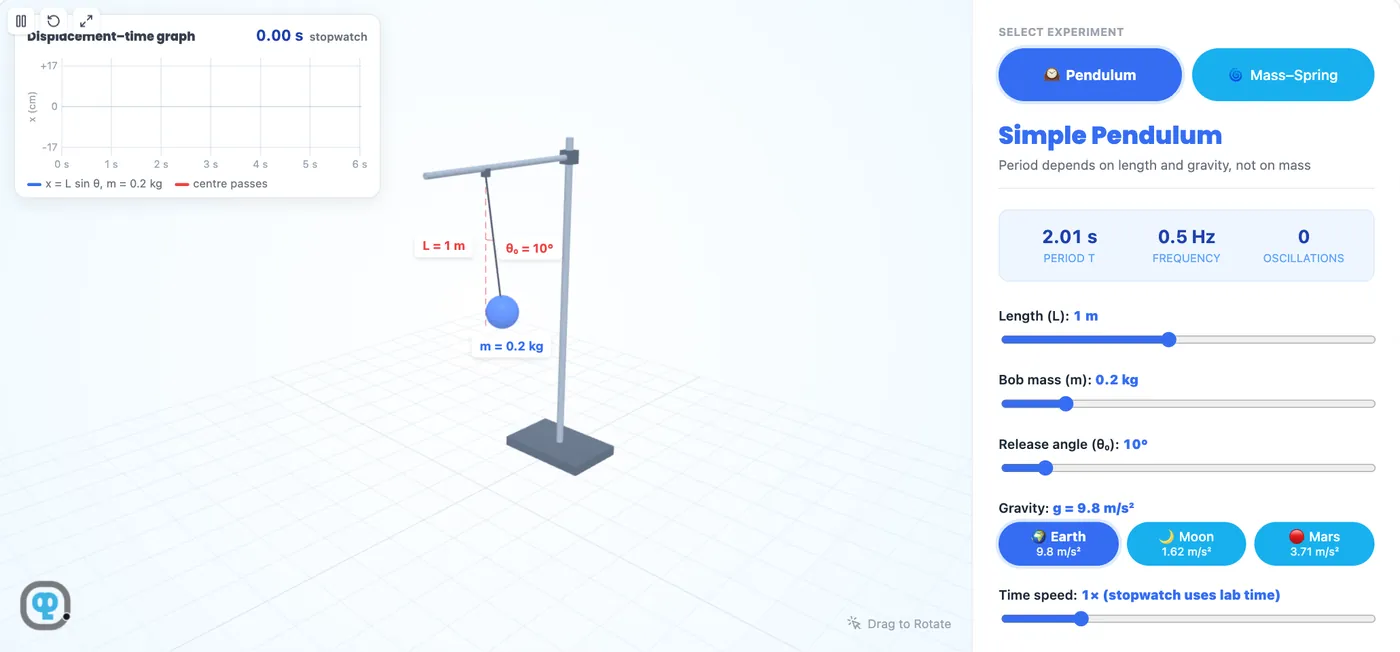
Pendulum & Spring
Swing a simple pendulum and bounce a mass on a spring on Earth, the Moon or Mars. Change length, mass, angle and spring constant, watch the live displacement–time graph and time 10 oscillations with a stopwatch to measure the period, just like the textbook experiment.
Used in 2 lessons
 Classroom game
Physics · Grades 9–10
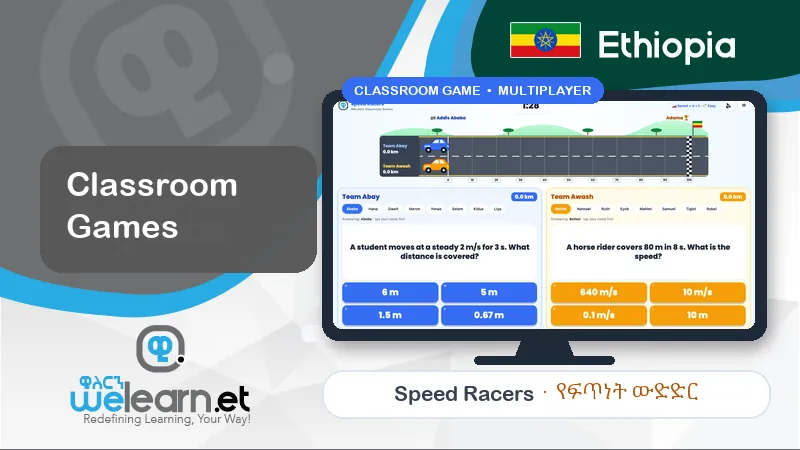
Speed Racers
የፍጥነት ውድድር
Two team cars race from Addis Ababa to Adama: every right answer accelerates your car, fast answers boost harder and wrong ones skid. Speed, km/h ↔ m/s, average speed, acceleration, motion graphs and the equations of motion.
Used in 8 lessons
FAQ
About Grade 9 Physics
What do students learn in Grade 9 Physics?
Grade 9 physics starts by asking what physics is and how it shapes society, then builds measurement skills with SI units and conversions. Students describe straight-line motion with graphs, apply Newton's laws, work, energy and power, analyse simple machines, and explore waves, sound and thermometry.
How many units are in Grade 9 Physics?
Grade 9 Physics has 7 units: Unit 1, Physics and Human Society; Unit 2, Physical Quantities; Unit 3, Motion in a Straight Line; Unit 4, Force, Work, Energy and Power; Unit 5, Simple Machines; Unit 6, Mechanical Oscillation and Sound Wave; Unit 7, Temperature and Thermometry.
Are there virtual labs or games for Grade 9 Physics?
Yes: Pendulum & Spring (virtual lab, Grade 9), Speed Racers (classroom game, Grades 9–10). They open inside the matching lessons on WeLearn.
Teach Grade 9 Physics with WeLearn
We will bring a demo to your school: a lesson on your interactive TV, a virtual lab and a classroom game, with your own teachers.