
Polynomial functions model many real situations because they are easy to compute and their graphs are smooth. Areas and volumes naturally give quadratics and cubics; revenue and profit often become polynomials when price depends on quantity; and the height of a thrown object follows a quadratic in time.
Key terms
- Revenue
- income from sales, price × quantity
- Profit
- revenue minus cost
- Break-even point
- where profit is zero
- Optimisation
- finding the maximum or minimum value
- Realistic domain
- the values of the variable that make sense in context
Key formulas
Summary
- Areas, volumes, motion and profit lead to polynomial models.
- Always state the realistic domain.
- Break-even points are zeros of the profit polynomial.
- Interpret answers in context and reject impossible ones.
In everyday life: Small enterprises making injera baskets or leather bags can model profit as a polynomial in the number of items and find the break-even production level.
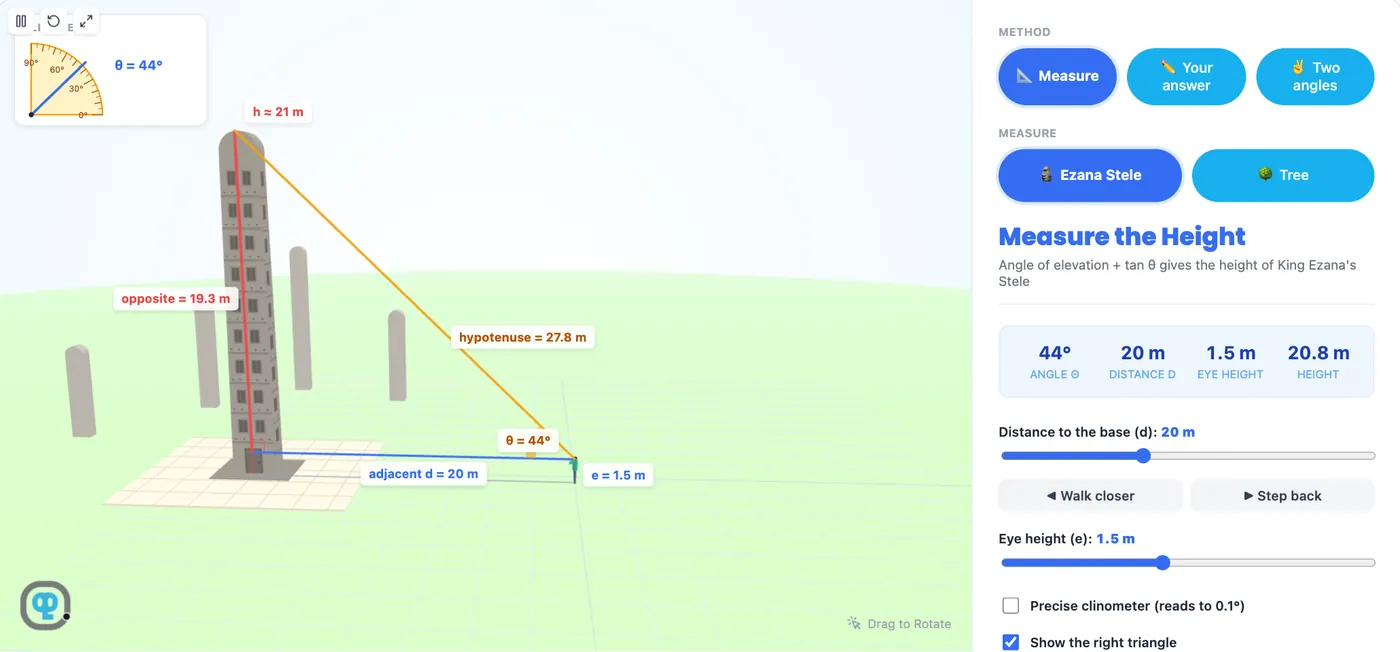
Try it in a virtual lab

Check yourself
- Write the volume of an open box from a 30 × 20 cm sheet with corner cuts x.
- If R(x) = 50x and C(x) = 200 + 10x, find the break-even quantity.
- Why is x = 12 impossible for a box made from a 20 cm square sheet?
On WeLearn
The full lesson: reading notes, worked examples, class activities and the Unit 2 quiz
Study Applications on WeLearnTeach Applications with WeLearn
We will bring a demo to your school: a lesson on your interactive TV, a virtual lab and a classroom game, with your own teachers.