
The graph of a polynomial is a smooth, continuous curve with no breaks, holes or sharp corners. Its overall shape is controlled by the leading term aₙxⁿ, because for large |x| that term dominates. This is called the end behaviour. If n is even and aₙ > 0, both ends rise (like y = x²); if n is even and aₙ < 0, both ends fall. If n is odd and aₙ > 0, the graph falls on the left and rises on the right (like y = x³); if n is odd and aₙ < 0, it rises on the left and falls on the right.
Key terms
- End behaviour
- what the graph does as x → ±∞
- Turning point
- a point where the graph changes direction
- Local maximum/minimum
- highest/lowest point in a neighbourhood
- Sign chart
- a table showing where f(x) is positive or negative
- Continuous curve
- a graph drawn without lifting the pencil
Key formulas
Summary
- Polynomial graphs are smooth and continuous.
- The leading term decides the end behaviour.
- At most n − 1 turning points.
- Sketch using zeros, multiplicities, y-intercept and end behaviour.
In everyday life: Road designers on the Addis–Adama expressway use polynomial curves for smooth transitions between straight sections, because polynomial graphs have no sharp corners.
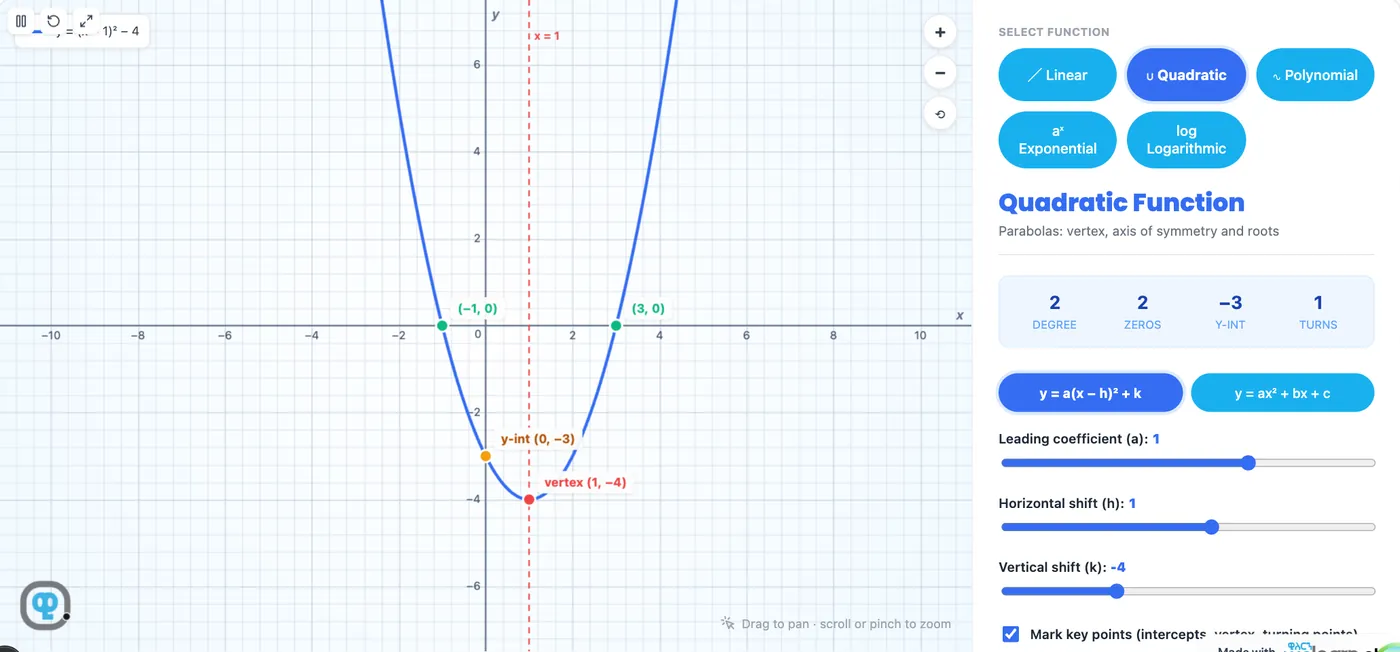
Try it in a virtual lab
Check yourself
- Describe the end behaviour of y = 3x⁴ − x.
- What is the maximum number of turning points of a degree 5 polynomial?
- Does y = (x − 4)² cross or touch the x-axis at 4?
Practice questions
1. How does the graph of f(x) = −2x⁴ + x behave at its ends?
- A. Rises on both ends
- B. Falls on both ends
- C. Falls left, rises right
- D. Rises left, falls right
Show answer
Answer: Falls on both ends
The leading term −2x⁴ has even degree and a negative coefficient, so for large |x| it is very negative: both ends fall.
On WeLearn
The full lesson: reading notes, worked examples, class activities and the Unit 2 quiz
Study Graphs of Polynomial Functions on WeLearnTeach Graphs of Polynomial Functions with WeLearn
We will bring a demo to your school: a lesson on your interactive TV, a virtual lab and a classroom game, with your own teachers.