
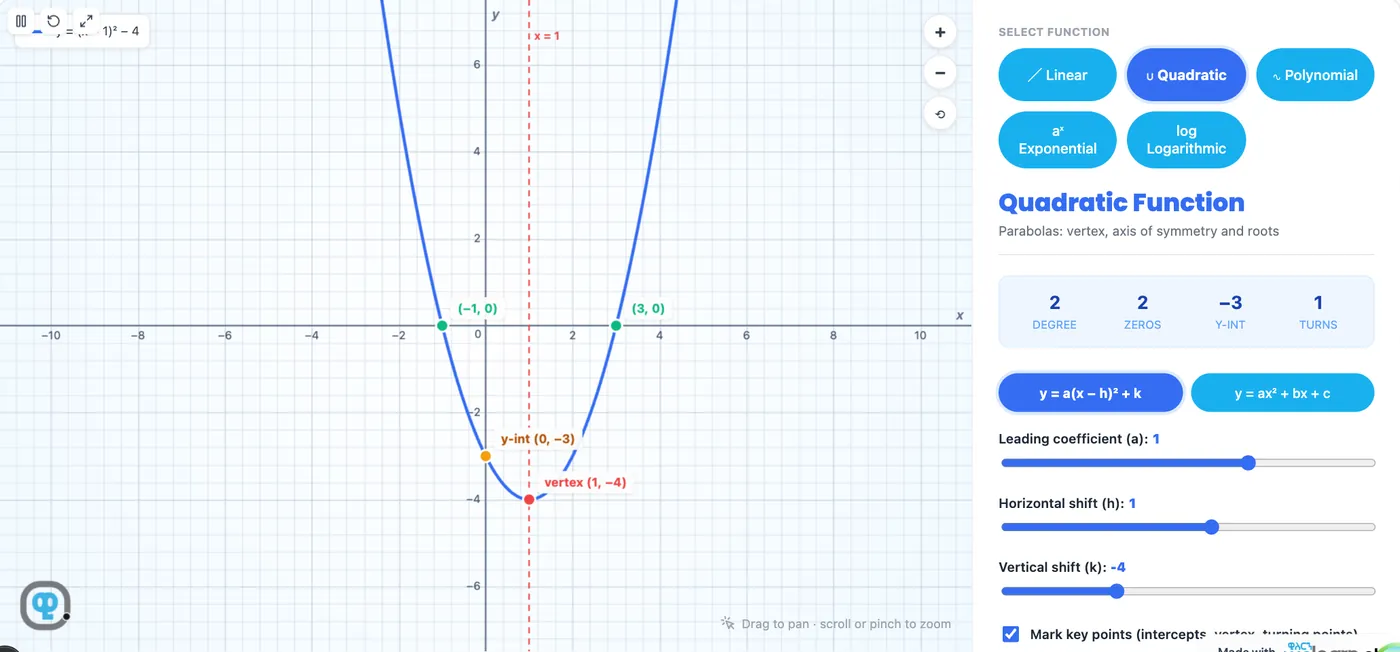
A zero of a polynomial f is a number c with f(c) = 0. Zeros of f are the solutions of the equation f(x) = 0, and real zeros are the x-intercepts of the graph. Finding zeros is the same as factorising: if c₁, c₂, … are zeros, then (x − c₁), (x − c₂), … are factors.
Key terms
- Zero of a polynomial
- a value where f(x) = 0
- x-intercept
- a point where the graph meets the x-axis
- Multiplicity
- the number of times a factor (x − c) is repeated
- Discriminant
- b² − 4ac, which decides whether a quadratic has real zeros
- Factoring by grouping
- pairing terms to extract a common factor
Key formulas
Summary
- Zeros of f solve f(x) = 0 and give the x-intercepts.
- Degree n means at most n real zeros.
- Odd multiplicity: graph crosses; even multiplicity: graph touches.
- Use candidates, test, divide, then solve the quadratic quotient.
In everyday life: A teff trader modelling profit P(x) as a polynomial in the number of quintals sold finds the break-even points by solving P(x) = 0.
Try it in a virtual lab
Check yourself
- Find the zeros of x³ − 4x.
- What is the multiplicity of 3 in (x − 3)³(x + 1)?
- Why does x² + 9 have no real zeros?
Practice questions
1. Which are all the zeros of f(x) = x³ − 4x?
- A. 0 and 4
- B. −2 and 2
- C. −2, 0 and 2
- D. 0, 2 and 4
Show answer
Answer: −2, 0 and 2
Factor: x(x² − 4) = x(x − 2)(x + 2). Setting each factor to zero gives x = 0, 2 and −2.
On WeLearn
The full lesson: reading notes, worked examples, class activities and the Unit 2 quiz
Study Zeros of Polynomial Functions on WeLearnTeach Zeros of Polynomial Functions with WeLearn
We will bring a demo to your school: a lesson on your interactive TV, a virtual lab and a classroom game, with your own teachers.