
An object that moves only under gravity is in free fall. Near Earth's surface, all objects in free fall have the same downward acceleration, g ≈ 9.8 m/s², whatever their mass (if air resistance is ignored). Galileo showed this, overturning Aristotle's view that heavier objects fall faster.
Key terms
- Free fall
- Acceleration due to gravity (g)
- Maximum height
- Time of flight
- Air resistance
Key formulas
Summary
- Free fall: a = g ≈ 9.8 m/s² downward.
- At the top, v = 0 but a = g.
- H = u²/2g; T = 2u/g.
In everyday life: Water from the Blue Nile Falls (Tis Abay) accelerates downward at about 9.8 m/s², gaining speed as it falls about 40 m.
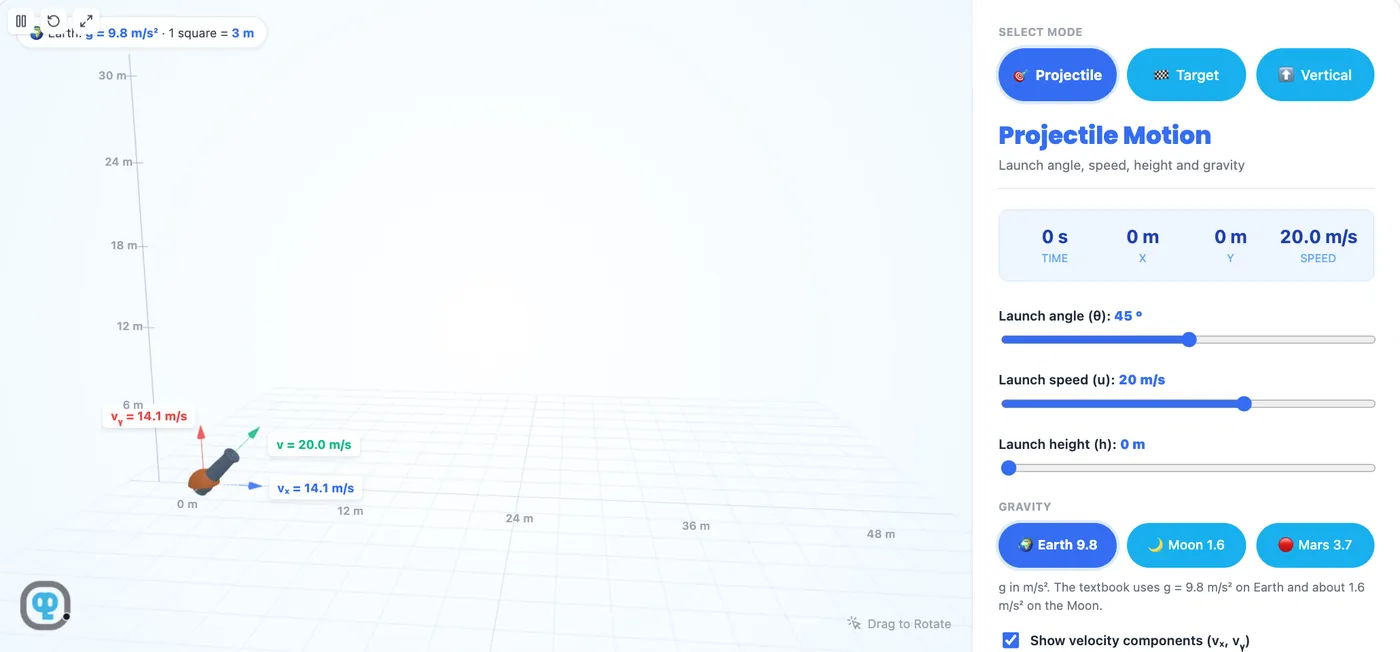
Try it in a virtual lab
Check yourself
- Does a heavier stone fall faster (no air)?
- A ball is thrown up at 10 m/s. How long until it stops rising?
- Why is upward motion symmetric with downward motion?
Practice questions
1. At the top of its flight, a ball thrown straight up has:
- A. Maximum velocity
- B. Zero velocity
- C. Zero acceleration
- D. Negative mass
Show answer
Answer: Zero velocity
Its vertical velocity is momentarily zero; acceleration is still g.
2. A ball is thrown up at 20 m/s. What maximum height (in m) does it reach? Use g = 10 m/s².
Show answer
Answer: 20
h = u²/2g = 400/20 = 20 m.
On WeLearn
The full lesson: reading notes, worked examples, class activities and the Unit 3 quiz
Study Vertical Motion on WeLearnTeach Vertical Motion with WeLearn
We will bring a demo to your school: a lesson on your interactive TV, a virtual lab and a classroom game, with your own teachers.