
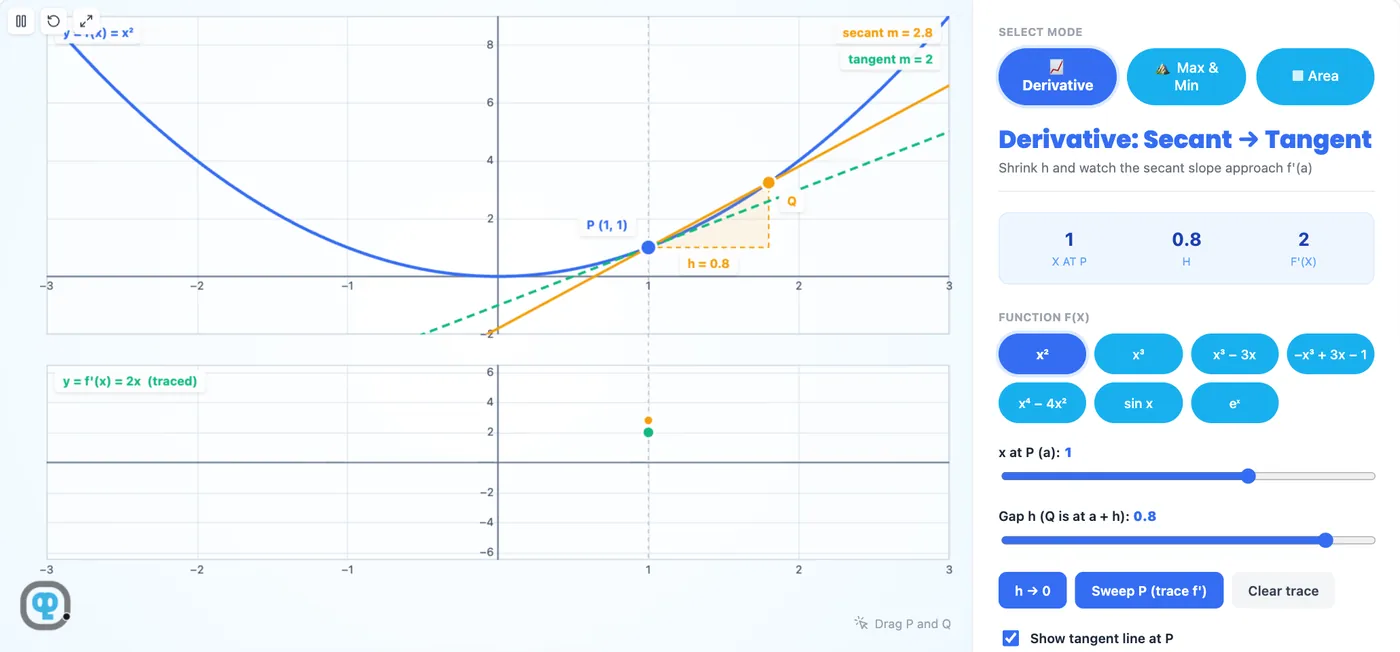
Calculus studies change. The average rate of change of a function f between x = a and x = a + h is [f(a + h) − f(a)]/h, which is the slope of the secant line joining two points on the graph. If we let h get closer and closer to 0, the secant line turns into the tangent line at x = a, and the average rate becomes the instantaneous rate of change. This limiting value is the derivative.
Key terms
- Average rate of change
- [f(b) − f(a)]/(b − a)
- Secant line
- a line through two points of a curve
- Tangent line
- the line touching a curve at one point with the same slope
- Derivative f'(x)
- the instantaneous rate of change
- Differentiable
- having a derivative at a point
- Power rule
- d/dx(xⁿ) = nxⁿ⁻¹
Key formulas
Summary
- The derivative is the limit of the average rate of change.
- f'(a) is the slope of the tangent at x = a.
- Power, sum, product and quotient rules speed up differentiation.
In everyday life: The speedometer of a minibus taxi shows instantaneous speed, which is the derivative of distance with respect to time.
Try it in a virtual lab
Check yourself
- Differentiate 4x⁵ − 3x² + 9.
- Find the slope of y = 1/x at x = 2.
- Differentiate (x² + 1)(x − 3) using the product rule.
Practice questions
1. What is the derivative of f(x) = 5x³ − 4x + 7?
- A. 15x² − 4
- B. 15x² − 4 + 7
- C. 5x² − 4
- D. 15x³ − 4x
Show answer
Answer: 15x² − 4
By the power rule, 5x³ → 15x², −4x → −4, and the constant 7 → 0.
2. Find the slope of the tangent to y = x² + 3x at x = 2.
Show answer
Answer: 7
y' = 2x + 3, so at x = 2 the slope is 4 + 3 = 7.
On WeLearn
The full lesson: reading notes, worked examples, class activities and the Unit 2 quiz
Study Introduction to Derivatives on WeLearnTeach Introduction to Derivatives with WeLearn
We will bring a demo to your school: a lesson on your interactive TV, a virtual lab and a classroom game, with your own teachers.