
The sign of the derivative tells us how a function behaves. If f'(x) > 0 on an interval, f is increasing there; if f'(x) < 0, f is decreasing. Points where f'(x) = 0 (or f' does not exist) are critical points; the tangent there is horizontal and the function may have a local maximum or minimum.
Key terms
- Critical point
- where f'(x) = 0 or f' does not exist
- Local maximum
- a point higher than its neighbours
- Local minimum
- a point lower than its neighbours
- Second derivative f''
- the derivative of f'
- Concavity
- the direction a graph bends
- Optimisation
- finding the best (max/min) value
- Marginal cost
- the derivative of total cost
Key formulas
Summary
- f' > 0: increasing; f' < 0: decreasing.
- Critical points are where f' = 0; classify them with f' sign change or f''.
- Optimisation: model, differentiate, solve, check endpoints.
- v = s', a = v'.
In everyday life: A small bakery in Bahir Dar can use derivatives of its profit function to find the number of loaves per day that gives the greatest profit.
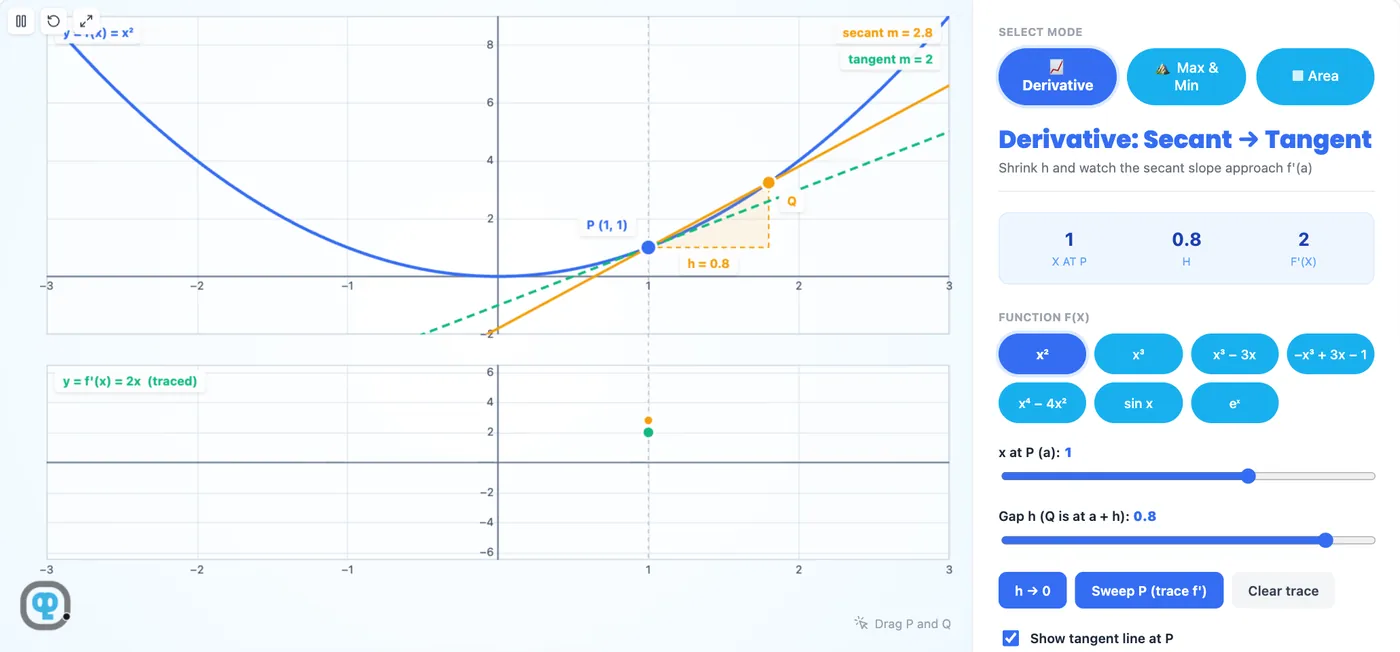
Try it in a virtual lab
Check yourself
- Where is f(x) = x² − 4x increasing?
- A particle has s = t³ − 6t². When is its velocity zero?
- Find two positive numbers with sum 20 and maximum product.
Practice questions
1. For f(x) = x³ − 12x, which point is a local minimum?
- A. x = −2
- B. x = 0
- C. x = 2
- D. x = 12
Show answer
Answer: x = 2
f'(x) = 3x² − 12 = 0 gives x = ±2. f''(x) = 6x is positive at x = 2, so x = 2 is a local minimum.
2. True or false: If f'(x) > 0 on an interval, then f is increasing on that interval.
Show answer
Answer: True
A positive derivative means every tangent slopes upward, so the function values rise as x increases.
On WeLearn
The full lesson: reading notes, worked examples, class activities and the Unit 2 quiz
Study Applications of Derivatives on WeLearnTeach Applications of Derivatives with WeLearn
We will bring a demo to your school: a lesson on your interactive TV, a virtual lab and a classroom game, with your own teachers.