
Integration is the reverse of differentiation. A function F is an antiderivative of f if F'(x) = f(x). Since the derivative of a constant is 0, antiderivatives are not unique: x², x² + 5 and x² − 3 all have derivative 2x. The indefinite integral ∫f(x)dx = F(x) + C collects all of them, where C is the constant of integration.
Key terms
- Antiderivative
- a function whose derivative is f
- Indefinite integral
- ∫f(x)dx = F(x) + C
- Constant of integration C
- Definite integral
- ∫_a^b f(x)dx, a number
- Riemann sum
- sum of rectangle areas approximating an integral
- Fundamental Theorem of Calculus
- links derivatives and integrals
Key formulas
Summary
- Integration reverses differentiation; add + C for indefinite integrals.
- ∫xⁿdx = xⁿ⁺¹/(n + 1) + C, n ≠ −1.
- ∫_a^b f dx = F(b) − F(a) gives signed area.
In everyday life: Engineers at the Grand Ethiopian Renaissance Dam can find the total volume of water entering the reservoir by integrating the river's flow rate over time.
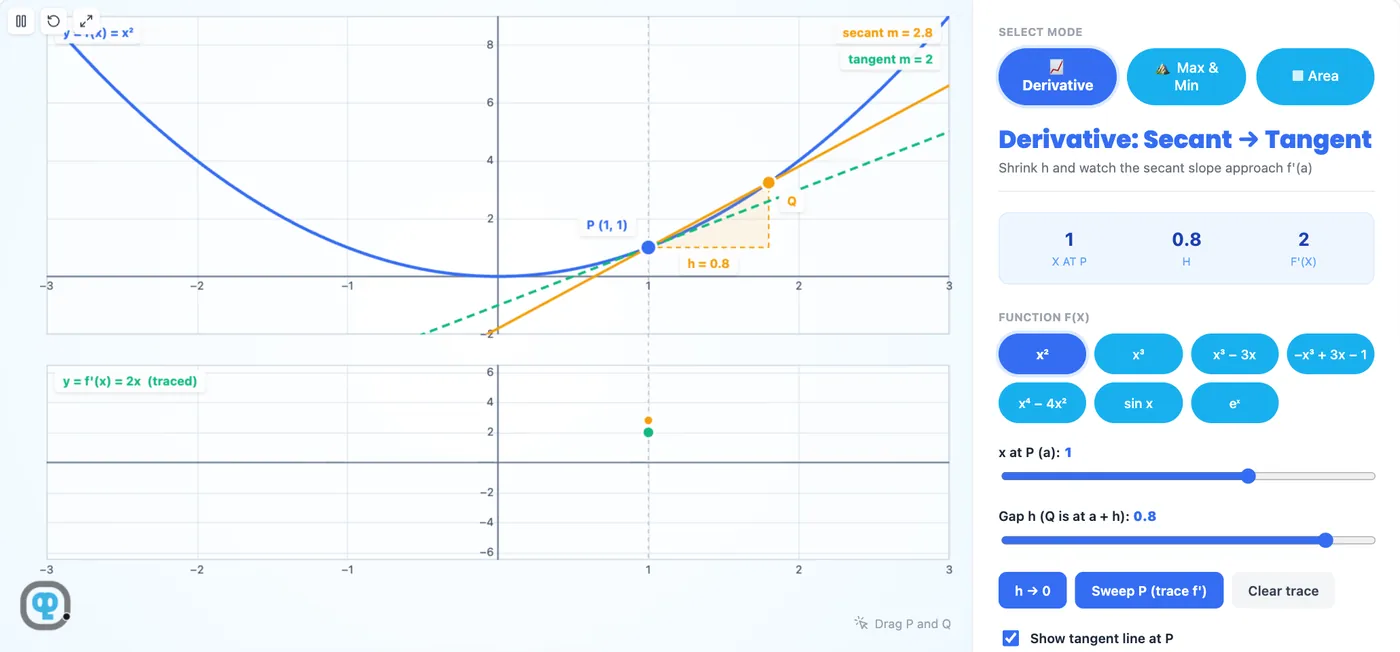
Try it in a virtual lab
Check yourself
- Find ∫(3x² + 2)dx.
- Evaluate ∫_1^2 4x³ dx.
- Why does an indefinite integral need + C?
Practice questions
1. Which is ∫(6x² + 2)dx?
- A. 12x + C
- B. 2x³ + 2x + C
- C. 6x³ + 2x + C
- D. 2x³ + C
Show answer
Answer: 2x³ + 2x + C
Reverse the power rule: 6x² → 6x³/3 = 2x³ and 2 → 2x; then add the constant C.
2. Evaluate the definite integral of 2x from x = 1 to x = 4.
Show answer
Answer: 15
An antiderivative is x², so the integral is 4² − 1² = 16 − 1 = 15.
On WeLearn
The full lesson: reading notes, worked examples, class activities and the Unit 2 quiz
Study Introduction to Integration on WeLearnTeach Introduction to Integration with WeLearn
We will bring a demo to your school: a lesson on your interactive TV, a virtual lab and a classroom game, with your own teachers.