
Newton realised that the force making an apple fall is the same force that keeps the Moon in orbit. His law of universal gravitation states that every particle in the universe attracts every other particle with a force that is directly proportional to the product of their masses and inversely proportional to the square of the distance between their centres: F = Gm₁m₂/r². G = 6.67 × 10⁻¹¹ N·m²/kg² is the universal gravitational constant, first measured by Cavendish.
Key terms
- Universal gravitation
- attraction between all masses
- Gravitational constant G = 6.67 × 10⁻¹¹ N·m²/kg²
- Inverse-square law
- force ∝ 1/r²
- Gravitational field strength g
- force per unit mass
- Orbital speed
- speed needed for a circular orbit
- Geostationary orbit
- 24-hour orbit above the equator
Key formulas
Summary
- F = Gm₁m₂/r² acts between all masses.
- Gravity follows an inverse-square law.
- g = GM/R² at a planet's surface.
- Gravity provides the centripetal force for orbits and explains Kepler's laws.
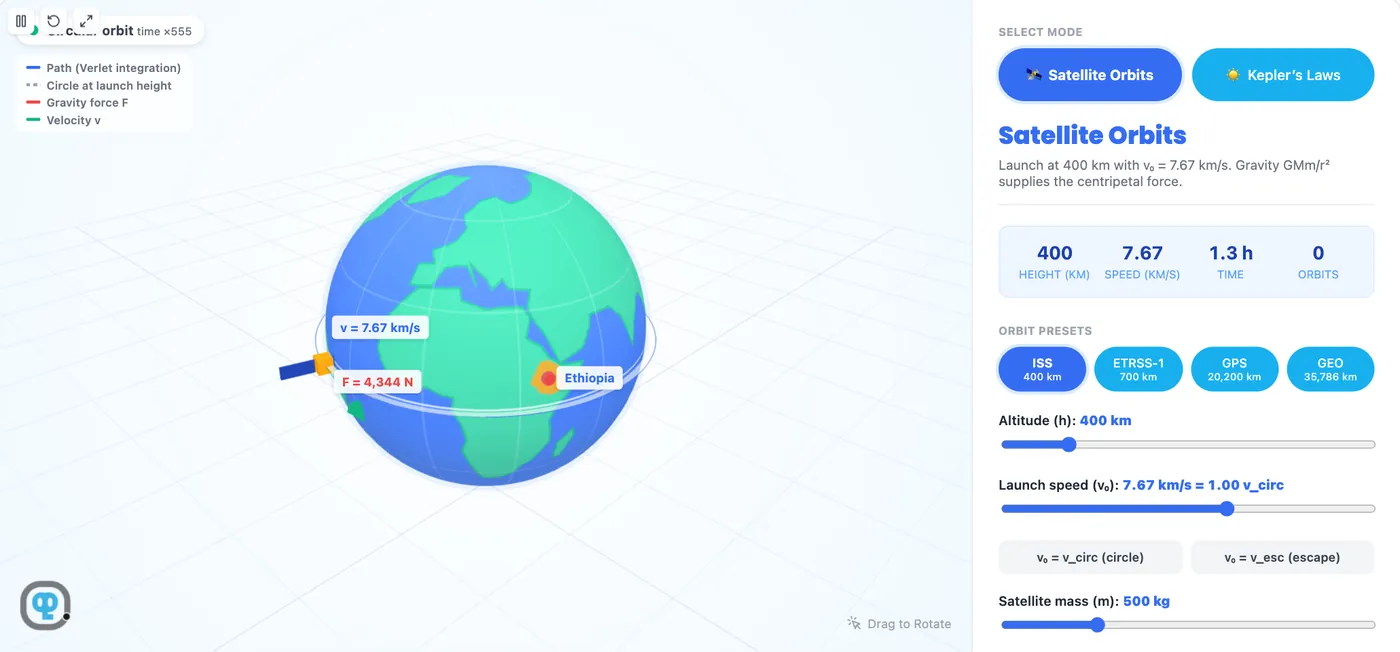
In everyday life: Ethiopia launched its first satellite, ETRSS-1, in 2019; it stays in orbit because Earth's gravity provides exactly the centripetal force it needs.
Try it in a virtual lab
Check yourself
- What happens to F if both masses double?
- Why don't we feel the attraction of nearby people?
- Why do astronauts in orbit feel weightless?
Practice questions
1. If the distance between two masses doubles, the gravitational force becomes:
- A. Half
- B. One quarter
- C. Double
- D. Four times
Show answer
Answer: One quarter
F ∝ 1/r².
On WeLearn
The full lesson: reading notes, worked examples, class activities and the Unit 2 quiz
Study Newton's Law of Universal Gravitation on WeLearnTeach Newton's Law of Universal Gravitation with WeLearn
We will bring a demo to your school: a lesson on your interactive TV, a virtual lab and a classroom game, with your own teachers.