
For centuries people believed the Earth was the centre of the universe (the geocentric model of Ptolemy). Copernicus proposed a heliocentric model with the Sun at the centre. Using Tycho Brahe's very accurate observations of Mars, Johannes Kepler discovered three laws (1609–1619) that describe exactly how planets move.
Key terms
- Geocentric model
- Earth-centred universe
- Heliocentric model
- Sun-centred solar system
- Ellipse
- oval orbit with two foci
- Perihelion and aphelion
- closest and farthest points from the Sun
- Orbital period
- time for one orbit
- Astronomical unit (AU)
- mean Earth–Sun distance ≈ 1.5 × 10¹¹ m
Key formulas
Summary
- Planets move in ellipses with the Sun at a focus.
- Equal areas in equal times: faster when closer.
- T² ∝ r³ for all planets of the Sun.
- Newton's gravity explains Kepler's laws.
In everyday life: The Ethiopian calendar's 13 months and the timing of farming seasons follow Earth's orbital period around the Sun, which Kepler's laws describe.
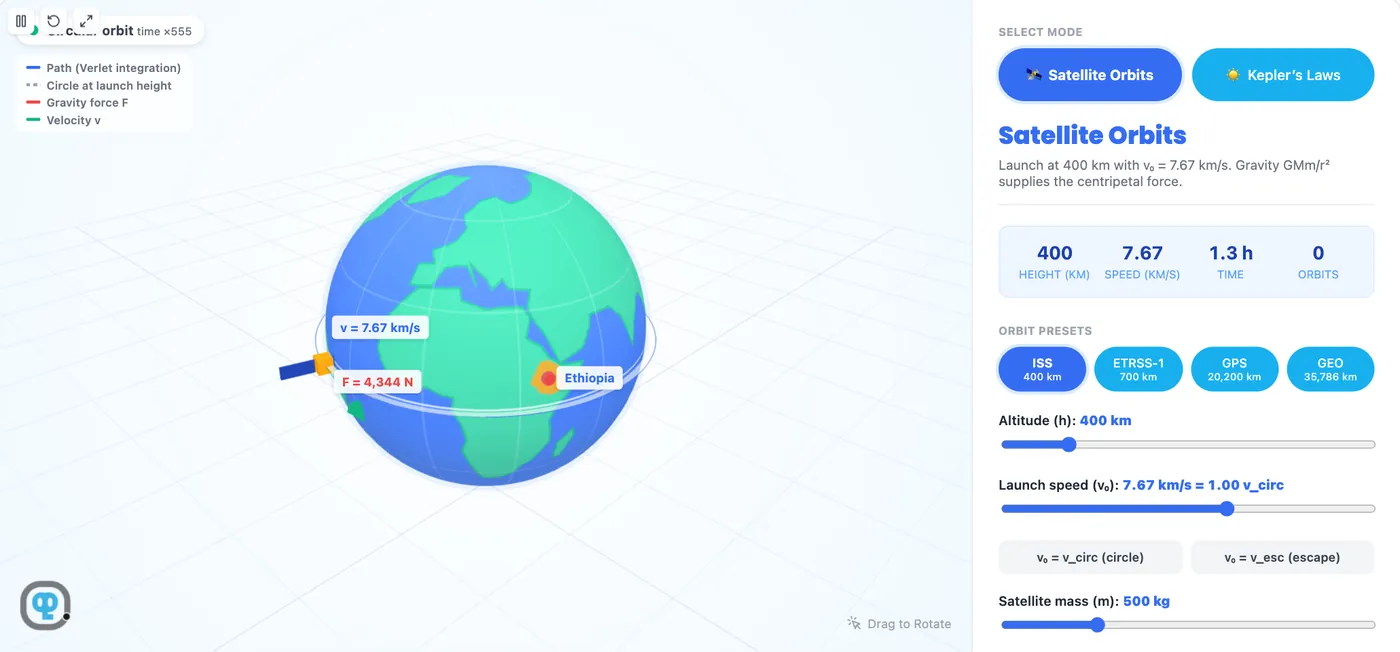
Try it in a virtual lab
Check yourself
- State Kepler's three laws.
- Where in its orbit does a planet move fastest?
- A planet is 4 AU from the Sun. Find its period.
Practice questions
1. According to Kepler's second law, a planet moves fastest when it is:
- A. Farthest from the Sun
- B. Closest to the Sun
- C. At any point equally
- D. Behind the Sun
Show answer
Answer: Closest to the Sun
Equal areas in equal times means faster when closer.
On WeLearn
The full lesson: reading notes, worked examples, class activities and the Unit 2 quiz
Study Planetary Motion and Kepler's Laws on WeLearnTeach Planetary Motion and Kepler's Laws with WeLearn
We will bring a demo to your school: a lesson on your interactive TV, a virtual lab and a classroom game, with your own teachers.