
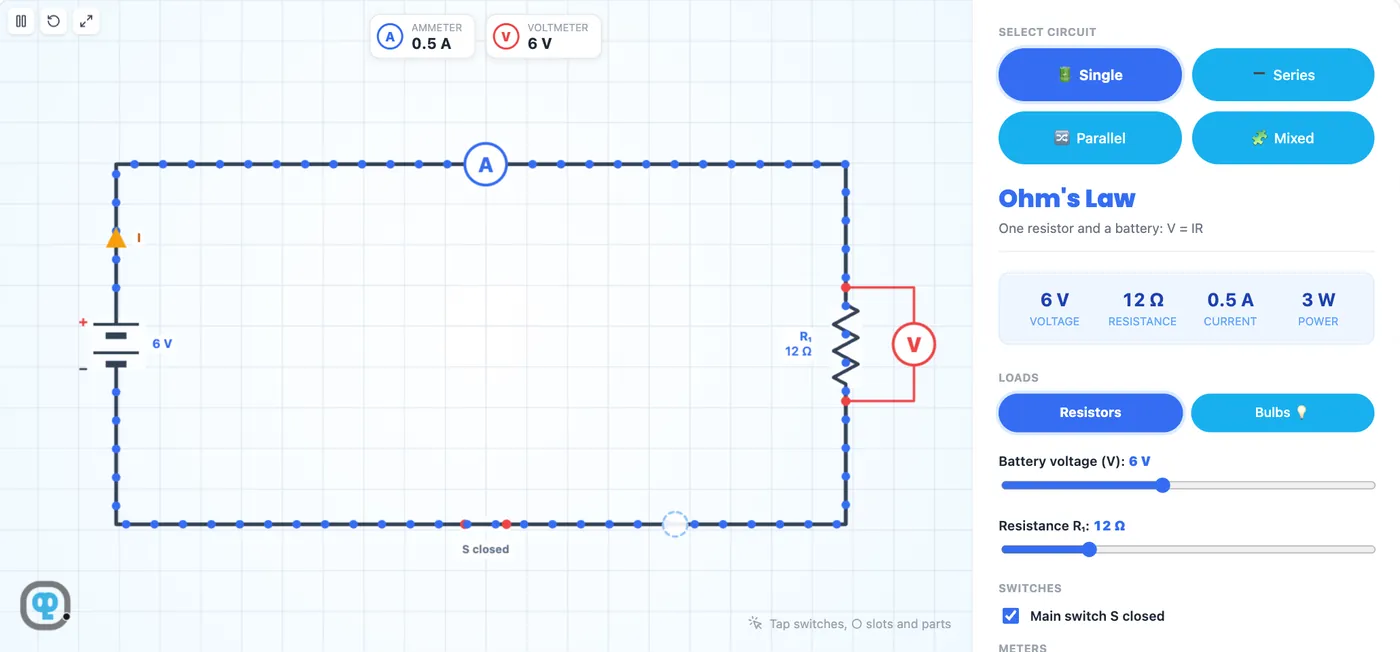
An electric circuit is a complete, closed path through which charge can flow. A circuit needs a source of energy (a cell, battery or generator), connecting wires, and a load that uses the energy, such as a lamp, motor or heater. A switch opens or closes the circuit.
Key terms
- Closed circuit
- Open circuit
- Conventional current
- from + to −
- Series circuit
- Parallel circuit
- Circuit symbols
Summary
- A circuit needs a source, wires and a load in a closed loop.
- Series: one path; parallel: several paths.
- Standard symbols are used in circuit diagrams.
In everyday life: A torch is a simple series circuit of batteries, a switch and a bulb; the lights in your house are wired in parallel.
Try it in a virtual lab
Check yourself
- Why does a bulb go out when the switch opens?
- Why are houses wired in parallel?
- Draw the symbol for a cell and a lamp.
On WeLearn
The full lesson: reading notes, worked examples, class activities and the Unit 4 quiz
Study Electric Circuits on WeLearnTeach Electric Circuits with WeLearn
We will bring a demo to your school: a lesson on your interactive TV, a virtual lab and a classroom game, with your own teachers.