
Electric current (I) is the rate of flow of charge: I = Q/t, measured in amperes (A). Voltage, or potential difference (V), is the energy given to each coulomb of charge, measured in volts (V); 1 V = 1 J/C.
Key terms
- Current (A)
- Voltage / potential difference (V)
- Resistance (Ω)
- Ohm's law
- V = IR
- Ohmic conductor
Key formulas
Summary
- I = Q/t; V = energy per coulomb.
- V = IR (Ohm's law).
- P = VI.
In everyday life: Thicker cables are used for electric stoves and water heaters in Ethiopian homes because they have lower resistance and carry large currents safely.
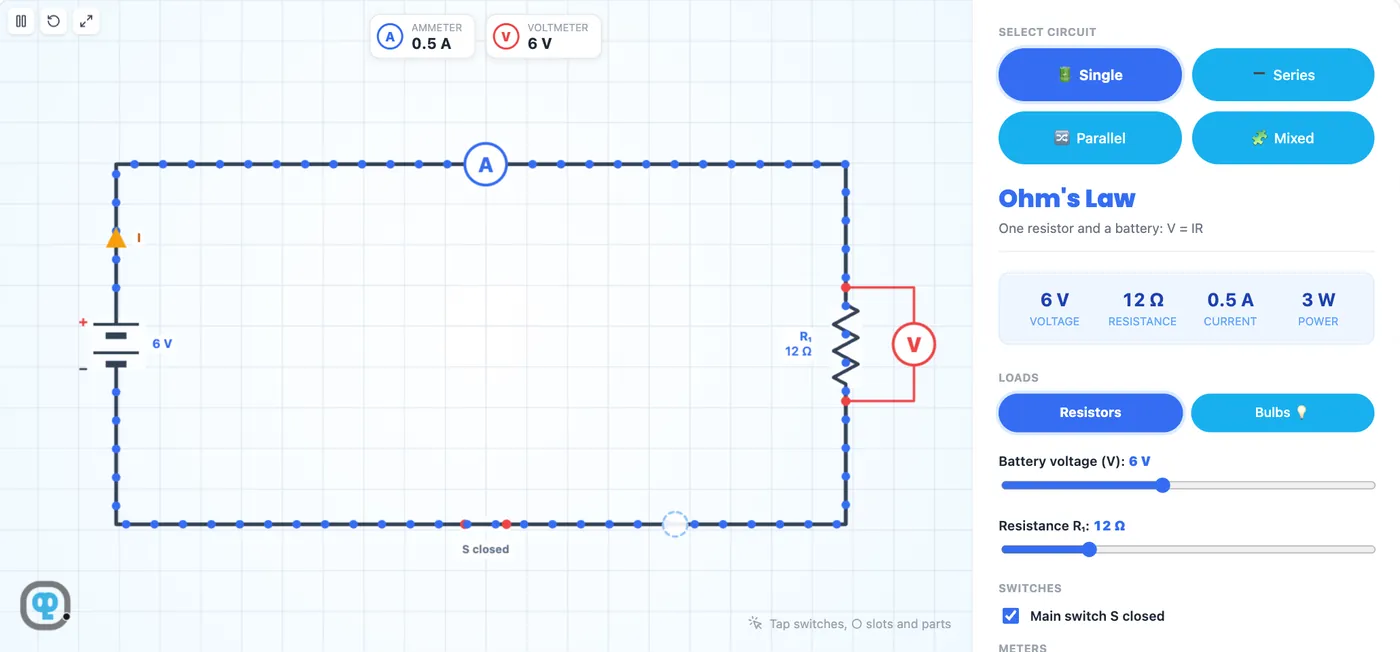
Try it in a virtual lab
Check yourself
- What current flows through a 4 Ω resistor at 8 V?
- Define one volt.
- What is the power of a 220 V heater drawing 5 A?
Practice questions
1. What current (in A) flows through a 4 Ω resistor connected to 8 V?
Show answer
Answer: 2
I = V/R = 8/4 = 2 A.
On WeLearn
The full lesson: reading notes, worked examples, class activities and the Unit 4 quiz
Study Current, Voltage and Ohm's Law on WeLearnTeach Current, Voltage and Ohm's Law with WeLearn
We will bring a demo to your school: a lesson on your interactive TV, a virtual lab and a classroom game, with your own teachers.