
Grade 10 Physics · Lesson 4.9
Combination of Resistors in a Circuit
Unit 4: Static and Current Electricity
In series, resistors are connected end to end. The same current flows through each, the voltages add up, and the total resistance is the sum: R = R₁ + R₂ + ... Adding resistors in series increases the total resistance.
Key terms
- Series combination
- Parallel combination
- Equivalent resistance
Key formulas
Summary
- Series: resistances add; same current.
- Parallel: reciprocals add; same voltage.
- Parallel total is less than the smallest resistor.
In everyday life: Every socket in a house is connected in parallel so each appliance gets the full 220 V and can be switched on or off independently.
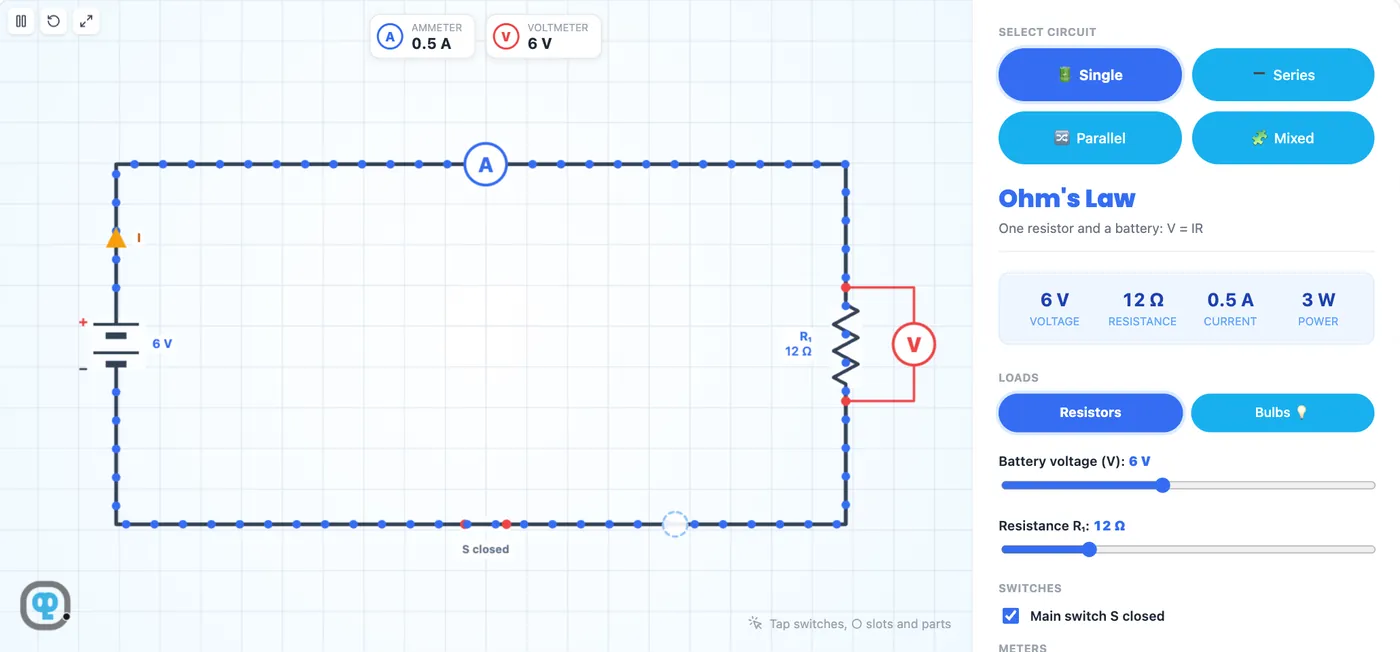
Try it in a virtual lab
Check yourself
- Total of two 6 Ω resistors in parallel?
- Total of 2 Ω, 3 Ω and 5 Ω in series?
- Why are house sockets in parallel?
Practice questions
1. What is the total resistance (in Ω) of 6 Ω and 3 Ω in series?
Show answer
Answer: 9
Rs = 6 + 3 = 9 Ω.
2. What is the total resistance (in Ω) of two 6 Ω resistors in parallel?
Show answer
Answer: 3
1/R = 1/6 + 1/6 → R = 3 Ω.
On WeLearn
The full lesson: reading notes, worked examples, class activities and the Unit 4 quiz
Study Combination of Resistors in a Circuit on WeLearnTeach Combination of Resistors in a Circuit with WeLearn
We will bring a demo to your school: a lesson on your interactive TV, a virtual lab and a classroom game, with your own teachers.