
Grade 10 Physics · Lesson 4.10
Voltmeter and Ammeter Connection
Unit 4: Static and Current Electricity
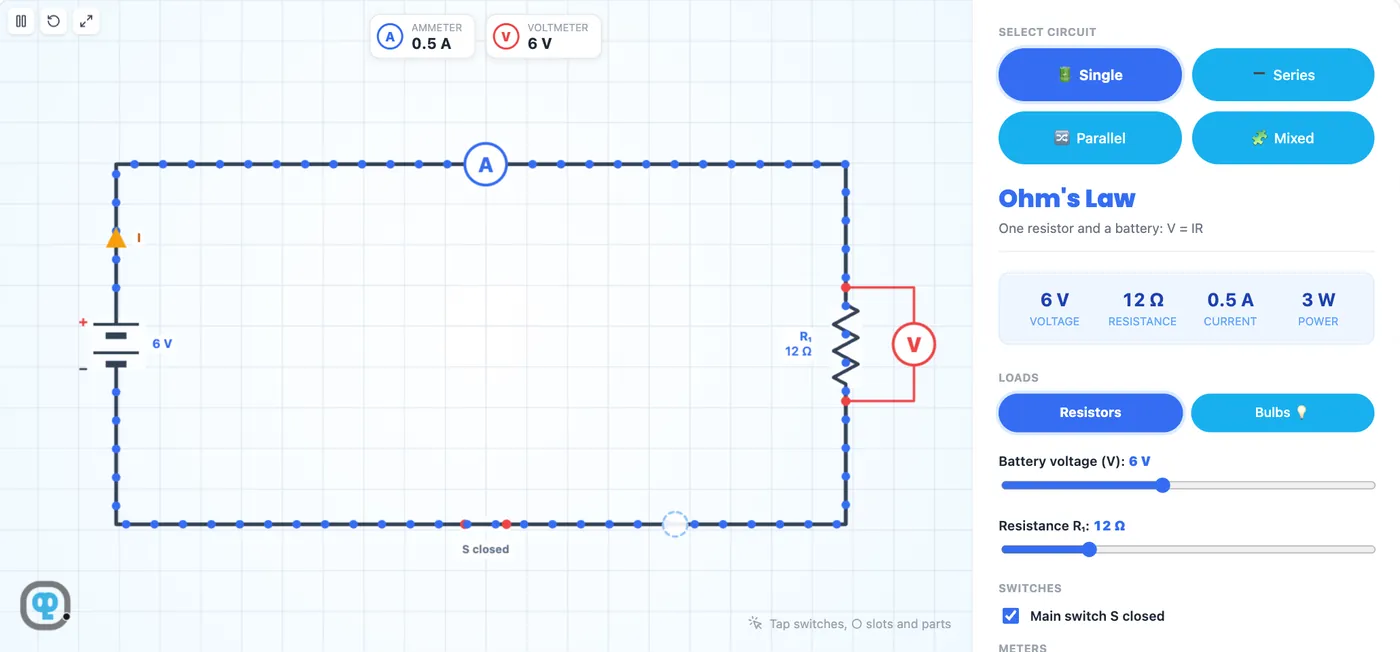
An ammeter measures current and must be connected in series, so that all the current flows through it. An ideal ammeter has zero resistance so it does not change the current it measures.
Key terms
- Ammeter
- measures current, in series
- Voltmeter
- measures voltage, in parallel
- Multimeter
- Short circuit
Summary
- Ammeter: in series, low resistance.
- Voltmeter: in parallel, high resistance.
- Wrong connection can damage meters or the circuit.
In everyday life: Electricians use a multimeter to check whether wires are live and whether a fuse or bulb is broken.
Try it in a virtual lab
Check yourself
- How must a voltmeter be connected?
- What happens if an ammeter is placed in parallel?
- Why should a voltmeter have high resistance?
Practice questions
1. An ammeter must be connected:
- A. In parallel
- B. In series
- C. Across the battery only
- D. To the earth wire
Show answer
Answer: In series
It measures current through the circuit, so it goes in series.
On WeLearn
The full lesson: reading notes, worked examples, class activities and the Unit 4 quiz
Study Voltmeter and Ammeter Connection on WeLearnTeach Voltmeter and Ammeter Connection with WeLearn
We will bring a demo to your school: a lesson on your interactive TV, a virtual lab and a classroom game, with your own teachers.