
Grade 10 Physics · Lesson 6.4
Laws of Reflection and Refraction
Reflection: when light hits a surface, the angle of incidence equals the angle of reflection, both measured from the normal (a line perpendicular to the surface). The incident ray, reflected ray and normal lie in the same plane. Plane mirrors form virtual, upright images the same size as the object and as far behind the mirror as the object is in front.
Key terms
- Normal
- Angle of incidence and reflection
- Refraction
- Refractive index n = c/v
- Snell's law
- Total internal reflection
- Critical angle
Key formulas
Summary
- Reflection: θi = θr.
- Refraction: bending due to change of speed; n₁ sin θ₁ = n₂ sin θ₂.
- Total internal reflection makes optical fibres work.
In everyday life: A stick standing in a water jar looks bent because light refracts at the water surface; Ethio Telecom's fibre-optic cables carry data using total internal reflection.
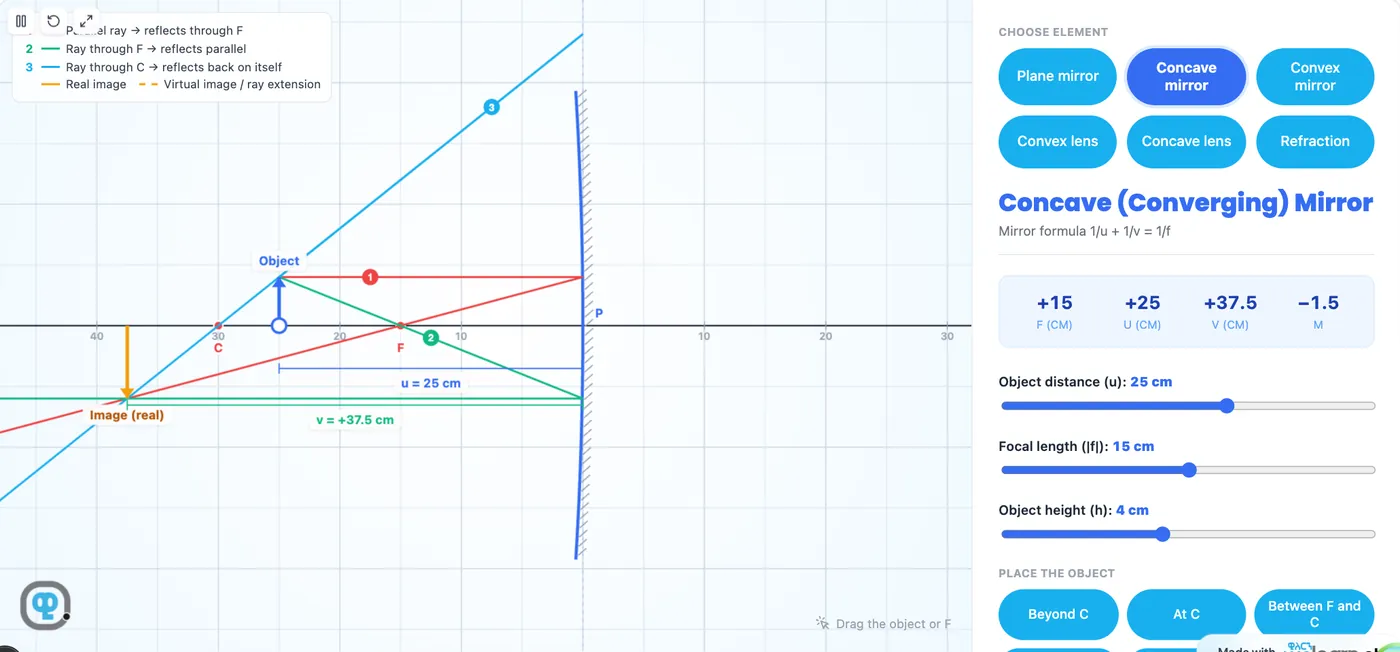
Try it in a virtual lab
Check yourself
- Light hits a mirror at 30° to the normal. Angle of reflection?
- Which way does light bend entering glass?
- Find the critical angle for glass with n = 1.5.
Practice questions
1. Light hits a plane mirror at 30° to the normal. What is the angle of reflection in degrees?
Show answer
Answer: 30
Angle of incidence = angle of reflection.
On WeLearn
The full lesson: reading notes, worked examples, class activities and the Unit 6 quiz
Study Laws of Reflection and Refraction on WeLearnTeach Laws of Reflection and Refraction with WeLearn
We will bring a demo to your school: a lesson on your interactive TV, a virtual lab and a classroom game, with your own teachers.