
Curved mirrors and lenses form images by reflecting or refracting light. A concave (converging) mirror and a convex (converging) lens bring parallel rays together at the principal focus F; a convex (diverging) mirror and a concave (diverging) lens spread rays out as if from a focus.
Key terms
- Concave and convex mirrors
- Converging and diverging lenses
- Principal focus (F)
- Focal length (f)
- Real and virtual images
- Magnification
Key formulas
Summary
- Converging: concave mirror, convex lens; diverging: convex mirror, concave lens.
- 1/f = 1/u + 1/v; m = v/u.
- Real images can be projected; virtual cannot.
In everyday life: Convex mirrors on sharp mountain-road bends give drivers a wider view; magnifying glasses help watch repairers and elderly readers.
Try it in a virtual lab
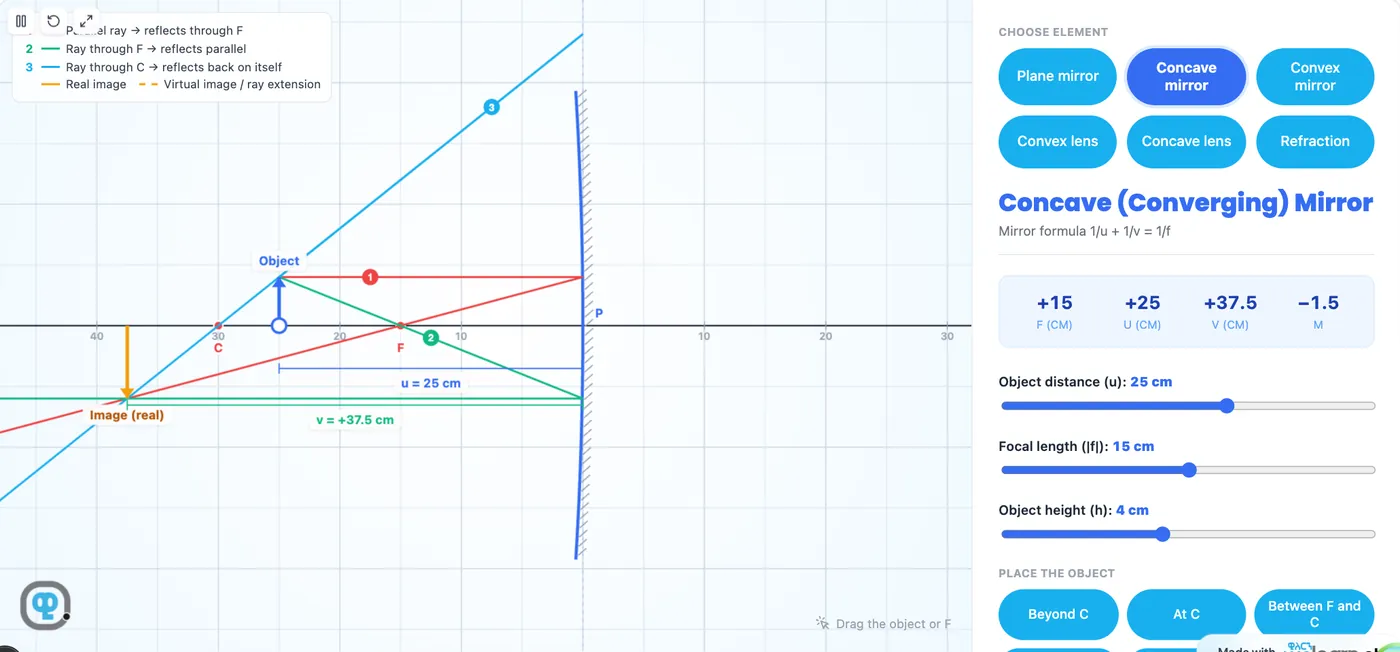
Check yourself
- Which lens is used as a magnifying glass?
- Find v for u = 20 cm, f = 10 cm.
- Why are convex mirrors used on road bends?
Practice questions
1. A lens has focal length 10 cm and an object is 30 cm away. What is the image distance in cm?
Show answer
Answer: 15
1/v = 1/10 − 1/30 = 2/30 → v = 15 cm.
On WeLearn
The full lesson: reading notes, worked examples, class activities and the Unit 6 quiz
Study Mirrors and Lenses on WeLearnTeach Mirrors and Lenses with WeLearn
We will bring a demo to your school: a lesson on your interactive TV, a virtual lab and a classroom game, with your own teachers.