
Grade 10 Physics · Lesson 6.6
The Human Eye and Optical Instruments
The eye works like a camera. Light enters through the cornea and pupil; the lens focuses it onto the retina, whose rod and cone cells convert light into nerve signals sent to the brain by the optic nerve. The iris controls the pupil size, and the ciliary muscles change the lens shape to focus on near or far objects (accommodation).
Key terms
- Cornea, iris, pupil, lens, retina
- Accommodation
- Myopia (short sight)
- Hypermetropia (long sight)
- Microscope
- Telescope
Summary
- The lens focuses light on the retina; accommodation changes focus.
- Concave lenses correct short sight; convex correct long sight.
- Cameras, microscopes and telescopes use lenses.
In everyday life: Free eye-screening campaigns in Ethiopian schools find students who need glasses; trachoma and cataracts are major causes of preventable blindness.
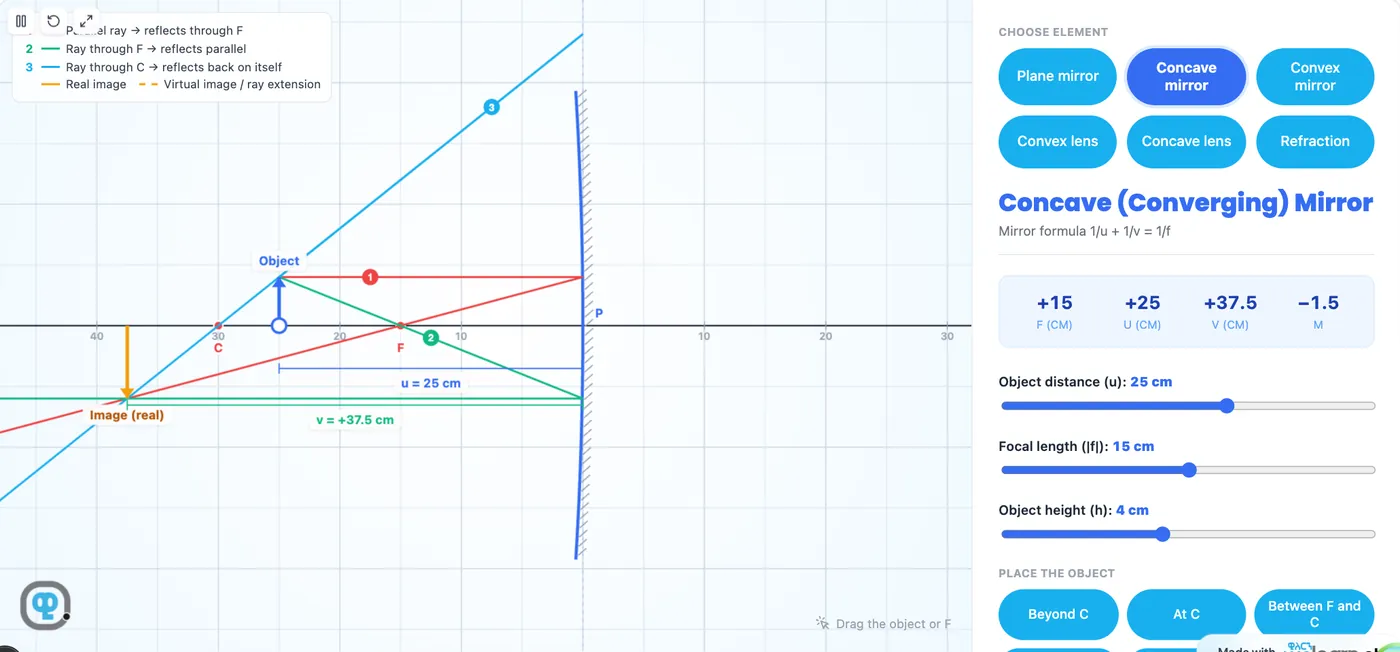
Try it in a virtual lab
Check yourself
- Which lens corrects short sight?
- What does the iris do?
- How does a microscope magnify?
Practice questions
1. Short sight (myopia) is corrected with a:
- A. Convex lens
- B. Concave lens
- C. Plane mirror
- D. Prism
Show answer
Answer: Concave lens
A concave lens diverges light so it focuses on the retina.
On WeLearn
The full lesson: reading notes, worked examples, class activities and the Unit 6 quiz
Study The Human Eye and Optical Instruments on WeLearnTeach The Human Eye and Optical Instruments with WeLearn
We will bring a demo to your school: a lesson on your interactive TV, a virtual lab and a classroom game, with your own teachers.