
Grade 9 Physics · Lesson 6.1
Common Characteristics of Waves
A wave is a disturbance that carries energy from one place to another without carrying matter along with it. When a stone drops into Lake Tana, ripples spread outward, but the water itself mostly moves up and down in place.
Key terms
- Wave
- a disturbance that transfers energy without transferring matter
- Crest and trough
- the highest and lowest points of a wave
- Amplitude
- maximum displacement from rest
- Wavelength (λ)
- distance between successive crests
- Frequency (f)
- waves per second, in hertz (Hz)
- Period (T)
- time for one wave, T = 1/f
Key formulas
Summary
- Waves transfer energy, not matter.
- Amplitude, wavelength, frequency and period describe a wave.
- v = fλ and T = 1/f.
In everyday life: Radio stations broadcast at a set frequency - when you tune to a station you choose the frequency (and therefore wavelength) of the waves your radio receives.
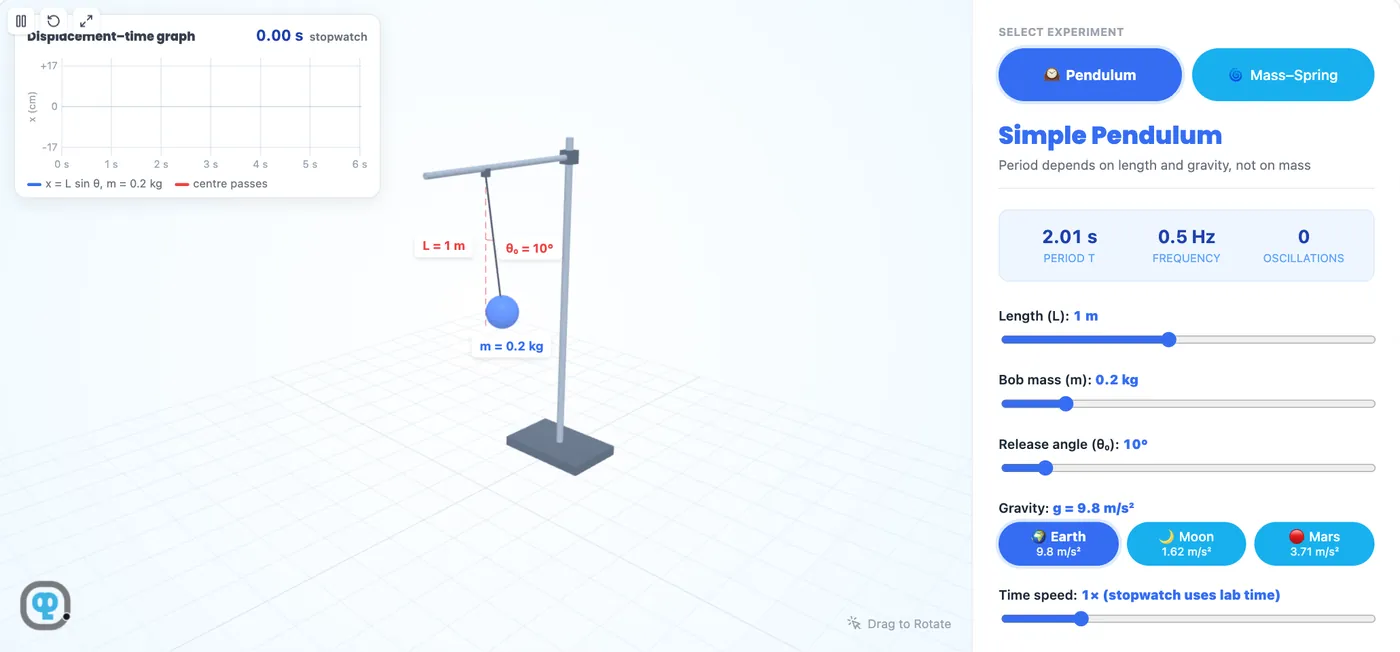
Try it in a virtual lab
Check yourself
- What does a wave transfer from place to place?
- A wave travels at 340 m/s with frequency 170 Hz. What is its wavelength?
- What happens to wavelength if frequency doubles at the same speed?
Practice questions
1. A wave has frequency 50 Hz and wavelength 2 m. What is its speed in m/s?
Show answer
Answer: 100
v = fλ = 50 × 2 = 100 m/s.
On WeLearn
The full lesson: reading notes, worked examples, class activities and the Unit 6 quiz
Study Common Characteristics of Waves on WeLearnTeach Common Characteristics of Waves with WeLearn
We will bring a demo to your school: a lesson on your interactive TV, a virtual lab and a classroom game, with your own teachers.