
Grade 9 Physics · Lesson 6.2
String, Pendulum and Spring
An oscillation is a repeated back-and-forth motion about a rest (equilibrium) position. A swinging pendulum, a mass bouncing on a spring and a plucked guitar or krar string all oscillate.
Key terms
- Oscillation
- repeated back-and-forth motion
- Equilibrium position
- the rest position of an oscillating object
- Simple pendulum
- a small mass on a light string swinging from a fixed point
- Spring constant (k)
- stiffness of a spring
- Natural frequency
- the frequency at which an object oscillates freely
Key formulas
Summary
- Pendulums, springs and strings all oscillate.
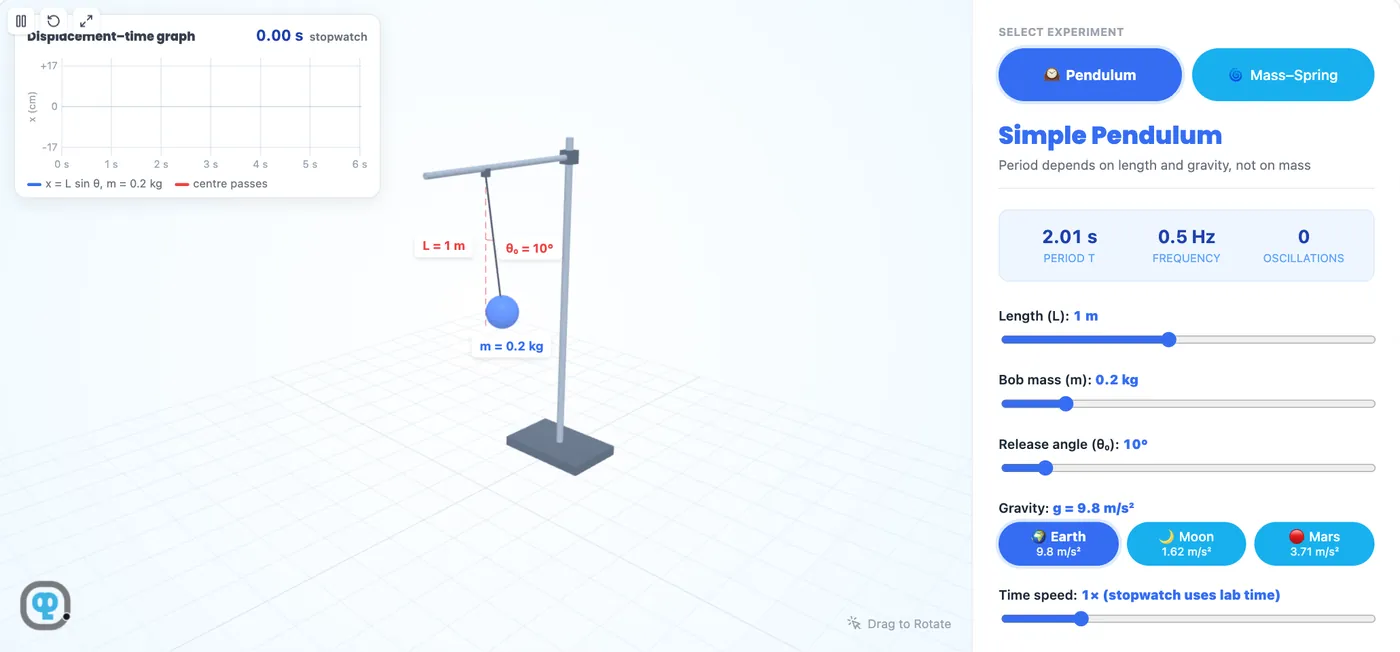
- A pendulum's period depends on its length and g, not its mass.
- Shorter, tighter strings vibrate at higher frequency.
In everyday life: The strings of a krar vibrate to make musical notes; tightening a string raises its pitch.
Try it in a virtual lab
Check yourself
- What happens to a pendulum's period if you make it longer?
- Does a heavier pendulum bob swing faster?
- How can you raise the pitch of a krar string?
Practice questions
1. The period of a simple pendulum depends on:
- A. Its mass
- B. Its length
- C. Its colour
- D. The amplitude only
Show answer
Answer: Its length
T = 2π√(L/g) depends on length and gravity.
On WeLearn
The full lesson: reading notes, worked examples, class activities and the Unit 6 quiz
Study String, Pendulum and Spring on WeLearnTeach String, Pendulum and Spring with WeLearn
We will bring a demo to your school: a lesson on your interactive TV, a virtual lab and a classroom game, with your own teachers.