WeLearn started with a very physical problem. In the summer break after the 2022/23 school year, we wanted students at Passion Academy in Addis Ababa to hold the shapes they were calculating with — not just see them drawn in a textbook. The school had a workshop and a pile of off-cuts. That was enough.
What is in the kit
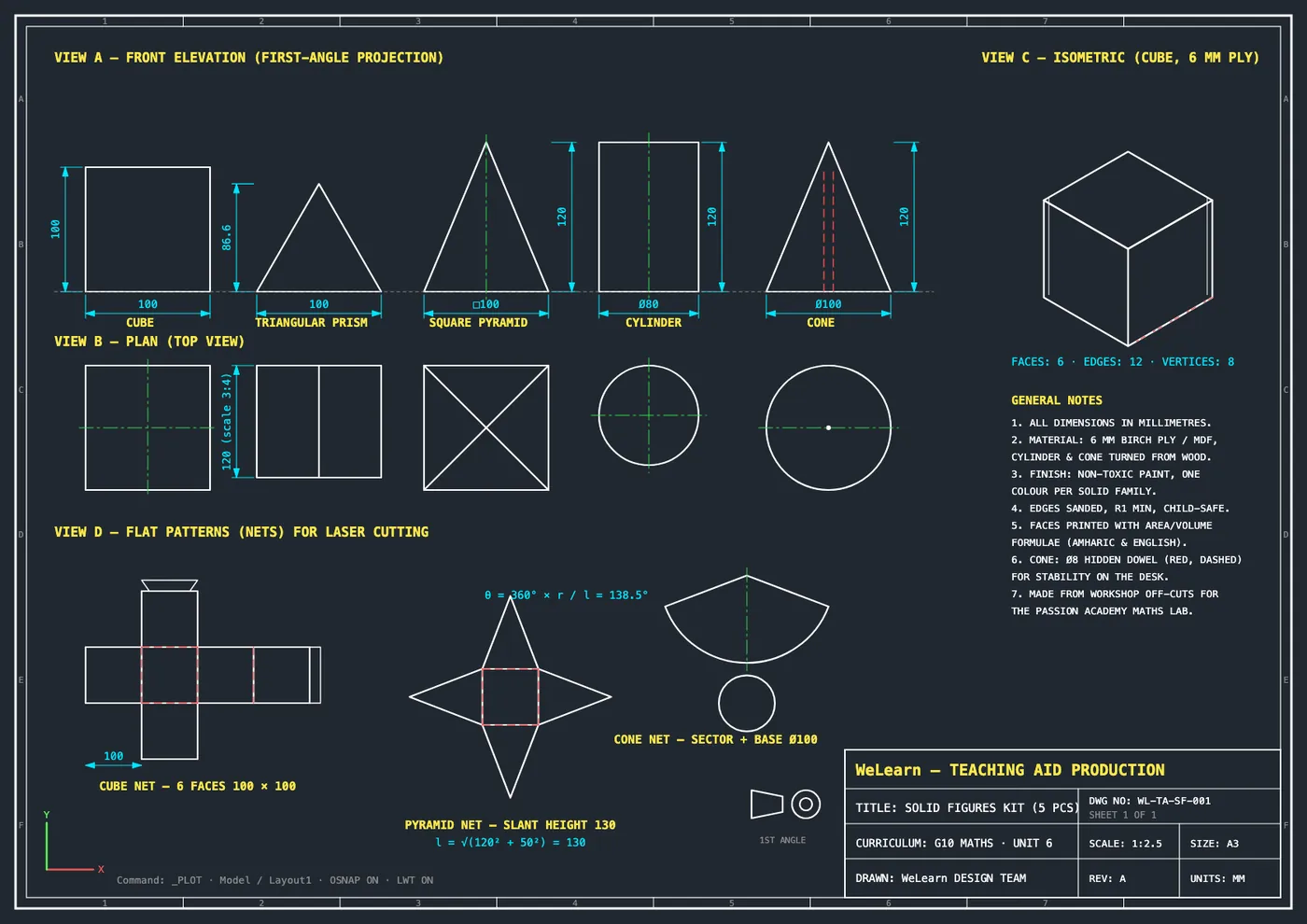
The kit covers the solid figures in the Grade 10 mathematics unit on surface area and volume:
- a cube,
- a triangular prism,
- a square pyramid,
- a cylinder,
- a cone.
Each piece is sized for classroom use (around 100 mm, so the back row can see it) and labelled with its measurements. The faces can carry the area and volume formulas in both Amharic and English.
Design notes
The drawing above is the actual production drawing: front elevation, plan, and the flat nets of each shape. A few lessons from making it:
- Draw the nets first. If a shape can be cut from a flat sheet and folded or glued, it is cheap to reproduce. Nets are also a lesson in themselves.
- Use round numbers. 100 mm sides make the arithmetic easy, so students focus on the method, not the multiplication.
- Sand every edge. Teaching aids are handled by dozens of students; safety and durability matter more than finish.
- Use one colour per family. Prisms one colour, pyramids and cones another — students start to see the relationships.
Pairing the kit with the virtual lab
A physical model and a virtual lab do different jobs:
| Physical model | Virtual lab |
|---|---|
| Students feel faces, edges and vertices | Every dimension can be changed instantly |
| Builds intuition for size and shape | Shows volume and surface area updating live |
| One set per class | Every student can open it at home |
In class, pass the model around while the 3D Solids lab is on the screen. Ask students to count faces and edges on the model, then check against the lab. Then change the height in the lab and ask: what happens to the volume if we double the height?
Make your own
You don't need a large budget. Plywood, MDF or thick cardboard off-cuts work; a saw, sandpaper, glue and paint are enough. Start with the cube and the cylinder — they come up most often — and add the others over time.
If you would like the production drawing for your school's maths lab, contact us.